Showing posts with label MILTON CANNIFF. Show all posts

Saturday, November 15, 2014

Sex In the Comics: Far-Out Sex

This is the final chapter to the book Sex in the Comics from 1985. Like I said before, the text is as big as possible (which is why I'm able to retype it in its entirety). The previous chapters, which I've also posted each Saturday, are probably linked to in the 'Linkwithin' blurbs at the bottom.

Here is the text by author Maurice Horn. I don't know how to feel about gay sex being implied as a perversion, though I guess if I were writing this book and had to compartmentalize different aspects of sex in the comics, and it was the 1980s, I might end up doing the same thing. Here is the last chapter of this book though.

For quite some time, but more particularly during the last two decades, the comics have been venturing far afield into the vagaries of sexual behavior, with cartoonists wading bravely into the murky waters of what are commonly called “deviations and perversions”. Many general encyclopedias still define “perverted sex” as any sexual act whose purpose is not procreation. That covers a lot of territory. It is not our intention in this chapter to catalogue each and every so-called deviation—a task better left to psychologists and sociologists—but to inquire as to the images, both positive and negative, that the comics have projected out of, and onto, this area of human behavior.

Of all the sexual minorities that deviate from the “straight” model of heterosexuality, homosexuals are, by sheer weight of numbers, the most visible. In an article in In Touch, Jerry Mills asserts, “Until recently, gay characters hardly ever appeared” in the comics. That assessment isn't strictly accurate. Homosexuals of both genders did appear in the comic pages as early as the twenties, although they were never characterized explicitly. If they were men, they were usually characterized as fussy and mincing, like the type who kept disrupting the trysts of Rosie and her beau, to the annoyance of both, or the openly “swishy” character who almost openly propositioned Moon Mullins with an offer of a job as a bodyguard, only to be given short shrift by the outraged Moon. Other blatantly effeminate characters also cropped up from time to time in such strips as Secret Agent X-9, Mandrake, and Dick Tracy (a pronounced lisp and gestures were among the telltale signs).

These were, however, only fleeting creations. Terry and the Pirates, on the other hand, featured supporting characters who exhibited unmistakable supporting characters who exhibited unmistakably homosexual (or ambiguously bisexual) proclivities. The corpulent, effeminate, Papa Pyson was a brigand chief who liked to be wheeled around his mobile chair by a muscular “aide de camp” and was tended to in his sybaritic pursuits by young limp-wristed minions. He strictly forbade his troops to have any intercourse with the corps of female prostitutes the Dragon Lady was keeping nearby as auxiliaries, and cringed and cringed at the very thought of close physical contact with a woman. An even more straightforward example was provided by Sanjak, a mysterious Double agent who turned out to be a woman by the name of Madame Sud, with more than professional designs on Terry's heartthrob April Kane. (That adventure took place in 1939 in what was then known as French Indochina—perhaps the first example of American involvement in Vietnam.) Later during the course of the war, Sanjak turned up again as Captain Midi, a dashing French air force captain but actually a spy for the Japanese in drag, and again her interest in April proved her undoing—a clear if double perverse case of cherchez la femme.
In the long history of the comics George Herriman stands apart in his mischievous delineation of Krazy Kat as a creature of indeterminate gender (Krazy Kat once described him/herself as both a bachelor and a spinster—wryly adding that this situation would last “until I get wedded”). Krazy Kat notwithstanding, it has been a slow march to toleration, if not acceptance, From Carl Barks' homophobic remarks in Donald Duck, where a sissified character asks museum guard Donald for “the lace and tatting collection” to Garry Trudeau's matter-of-fact understanding in Doonesbury, in which Joanie Caucus discovers that her old flame Andy is gay. In between came tales of sex change (in Weird Science and Camelot 3000) and attempted homosexual rape (in The Incredible Hulk) and even a story about the reunion of Captain America with his long-lost boyhood pal who grew up to become gay (Cap, of course, grew up to become a superhero, but that's another story). Finally, let's not forget S. Clay Wilson's notorious (and hilarious) Ruby the Dyke.

Until recently homosexuals in the comics were secondary or satirized characters. However, with the growth of the gay liberation movement and the proliferation of publications since the seventies, overtly homosexual characters have become full-fledged protagonists, often in their own comic features. Unfortunately more often than not these features are afflicted with a pornographic outlook that would make the readers of Hustler blush: the wealth of genitals on display is matched only by the poverty of the storyline. Even the strips that are more stylistically restrained are just as raunchy thematically, with an overabundance of salacious lines and off-color jokes. A character in Castro, for instance (the strip is named for the gay district of San Francisco, not the jolly Fidel of Cuba), exclaims after a visual inspection of his friends backside, “Honey, if I dropped dead now, I'd want to come right back as yer bicycle seat, an' roll around in heaven all day.”
The homosexual audience is apparently large enough to support at least one gay underground comic book. Gay Heart Throbs made its bow in the mid-seventies, lasted a few issues and was superseded by Gay Comix in 1980. Howard Cruse, an established cartoonist with Playboy, the National Lampoon and other publications, is the editor, and he has been able to attract a good number of talented cartoonists to his magazine, Rand Holmes and Burton Clarke have drawn covers, and his regular contributors include Robert Triptow (whose one-pager, Castroids, is also about the Castro district) and Dutch cartoonist Theo Bogart. The distaff side is well represented by Lee Marrs, who specializes in tales of tongue-in-cheek domination, Roberta Gregory, the editor of the first lesbian comic, Dynamite Damsels, and Mary Wings, former editor of the self-explanatory Dyke Shorts. The best thing about the magazine, however, is Cruse himself: his autobiographical Billy Goes Out is a quite poignant “coming out of the closet” story.
There have been a number of great stories about homosexual love (many of them by straight cartoonists) in Europe, notably in France and Holland, but no gay comic book has yet appeared there. Not so in Japan, where a magazine called Juné specializes in homosexual stories (mostly drawn by women artists!) and enjoys tremendous popular success with teenage readers of both sexes. In his excellent study of Japanese comics, Manga! Manga!, Frederick Schodt describes a typical issue of the 150-page magazine: “pin-up color photographs of androgynous foreign rock stars and scantily clad teenage boys, with poems; eleven comic stories and short strips about young gay men; a short, illustrated prose story of gay interracial love in prewar Japan” along with “drawings by readers of young boys embracing; reviews of amateur comic magazines devoted to the 'beautiful boy'; confessions of gay love, purportedly written by readers”, etc.

If homosexuality has been the most prevalent sexual deviation in real life, sadomasochism has been the most frequently depicted sexual perversion in the comics. As a matter of fact, in the forties and the fifties, there was an entire category of comic books that specialized in picturing women in provocative and often submissive poses for the delectation of adolescent male readers. The drawings, especially those on the covers, constituted the main attraction, with plot and characterization most often very skimpy indeed—a fact that did not unduly disturb aficionados of the genre (who, after they grew up, took to referring to that brand of illustration as “good girl art”, a term that has angered feminists to no end). The trend even spilled over into mainstream comics of the time, with newspaper strips like Steve Canyon, Rip Kirby, and Dick Tracy occasionally delving into sadism and bondage.

There were quite a few publishers of sadomasochistic comics, but Fox Publications and ME Comics were generally acknowledged as leaders of the form. In title after gaudy title (Phantom Lady,Cave Girl, Jungle Lil, Thunda, etc.) they offered women in all kinds of deranged positions—bound and gagged, tied to racks, threatened with whips and branding irons, molested by freaks and degenerates—all drawn in exquisite detail by such masters as Bob Powell, Matt Baker, and Frank Frazetta. These beauties never failed to display an over-abundance of charms; in fact, the artists pushed breast fetishism to such ludicrous extremes that it had an undesirable side effect of attracting the special ire of Dr. Wertham. “One of the stock mental aphrodisiacs is to draw girls' breasts in such a way that they are sexually exciting”, he fulminated in Seduction of the Innocent. “Whenever possible they protrude and obtrude”.

After the Comics Code came into effect, the theme of breast fetishism and bondage found their outlet in scores of semiunderground publications catering to an impressively large clientele. In these unbridled tales of illustrated erotic fantasy all the women were big-busted and scantily clad, or else they went around in leather outfits and highly-laced boots. They generally operated in a world devoid of men (an intriguing psychological quirk), with the “bad girls” (usually older) submitting the “good girls” to a fiendish array of ordeals, degradations, and tortures. No overtly sexual act was ever performed, a fact that inclined the authorities towards indulgence, and the genre accordingly flourished into the sixties,when the appearance of more sexually explicit comic stories soon took away from their raison d'être. Most of these publications were artistically god-awful and nauseating in their repetitiveness, but two achieve cult status due to their better-than-average storylines and outstanding artwork. One, Sweet Gwendoline, is the tale of a nubile innocent victimized by a succession of sadistic females, drawn first by John Scott Coutts (under the pseudonym John Willie), and later Eric Stanton; the other Princess Elaine, by Eneg (Gene Bilbrew), depicts the erotic adventures of a cruel blonde dominatrix.
The most fertile ground for sadomasochistic comics proved to be Europe, where the genre found its maestro assoluto in the person of Guido Crepax. Working almost exclusively in black and white, Crepax is best known for the beautiful loving depiction of young women victimized in the course of disturbing sadomasochistic adventures. La Casa Matta(“The Mad House”, later reworked as Bianca), in which a nubile schoolgirl daydreams and fantasizes her way into a cruel, erotic universe where her schoolmates, teachers and relatives become her lovers and/or tormentors, in classic Crepax fare. So is Anita, an alarming tale of sexual obsession eventually leading to self-immolation.
These predilections made Crepax the perfect choice as illustrator of two of the most celebrated models of modern erotic literature, Pauline Réage's Story of O and Emmanuelle Arsan's Emmanuelle. It should be noted that Crepax's treatment is much more faithful to the originals than their watered-down screen adaptations, Story of O in particular—described by novelist André Pieyre de Mandiargues as “the tragic flowering of a woman in the abdication of her freedom, in willful slavery, in humiliation, in the prostitution imposed upon her by her masters, in torture, and even the death which, after she has suffered every other ignominy, she requests and they agree to”—found in Crepax its ideal interpreter.
After these two resounding successes it was probably inevitable that the artist would go on to illustrate the works of the man who gave sadism its name, the Marquis de Sade himself. Crepax's Justine, based on Sade's quintessential novel of innocent womanhood tormented, abused and debased, is somewhat of a disappointment, however. This may be due to the fact that the phantasms conjured by the “divine marquis” are in the last analysis too abstract, too cerebral to be adequately expressed in graphic terms; conversely, it may be because the philosophical outpourings of the author, whose prose was respectfully preserved, tend to overshadow the artist's illustrations.

Crepax's Valentina also veers away from the straight storytelling towards straight fantasy making, half oneiric and half hallucinatory, with an overpoweringly sadomasochistic current. In the course of her wanderings Valentina travels through space and time in a universe untrammeled by rules or rationality, where she meets in turn rampaging Mongols, brutal concentration camp guards, libidinous space aliens, vicious Amazon queens and every imaginable figure of fact and legend (Bluebeard and Archimedes, Lenin and Morgan le Fey, among others). Against a splendid baroque background reeking of sensuality and decadence, Valentina is usually the victim of the most barbarous treatments: raped, whipped, quartered, impaled and branded, she always emerges Phoenix-like from her ordeals, unmarked and apparently untouched.

Of all the villains, male and female, human and animal, who constantly plague the heroine, none is so prominent or colorful as Baba Yaga, inspired by a legendary witch in Russian folklore. As depicted by Crepax, Baba Yaga is a desiccated lesbian crone who favors turn-of-the-century fashions and tries to lure Valentina away from her lover. She dons various guises to this end and in particular replays the role of the bad witch in updated versions of fairy tales such as Snow White and Hansel and Gretel. In these allegories Crepax seems to be telling us that sadomasochistic fantasy is the modern equivalent of the fairy tales of old.
Crepax notwishstanding, it tis perhaps fitting that the most outré of all sadomasochistic comic heroes should have been conceived by a Frenchman. With Marie-Gabrielle de Sainte-Eutrope, George Pichard crowned his already notorious career py pulling out all the stops in a horrendous tale of a buxom,dark-haired beauty subjected to every conceivable form of torture and torment—in full color and minute detail. Perhaps a takeoff on one of Sade's most famous anthology pieces—wherein Justine and her companions are victimized by an order of monks—Pichard has Marie-Gabrielle and her cellmates tormented by nuns who kept piously reciting the catalogue of tortures visited upon by Christian saints and martyrs, while meting out the most barbarous treatment to their helpless charges. The author then produced a sequel, Marie-Gabrielle en Orient, in which he set out to demonstrate that when it comes to torture inflicted on women, all men are brothers under the skin.
Not surprisingly, comics depicting the sexual fantasies of women are relatively rare in this male-dominated medium. There are exceptions, however, French cartoonist Marcelé has authored a number of comics showing strong, beautiful and cruel women bringing cowering, flabby middle-aged men to heel. In the United States, in 1972, Chin Lyvely and Joyce Farmer started an all-woman comic with the provocative title Tits and Clits. “It was a great success,” the co-founders later mused, “either because the subject matter was unusual and (some say) revolting, or because many people were willing to pay 50 cents for a magazine with the title of Tits and Clits.”

The focus of Tits and Clits was on female sexuality, as, to a certain degree, was that of Wimmen's Comics, which also appeared in 1972. Their subject matter, however, proved tame in comparison with that of Wet Satin, which openly proclaimed itself to be about “women's erotic fantasies,” many of which turned the table on male sexual ethos with a vengeance.

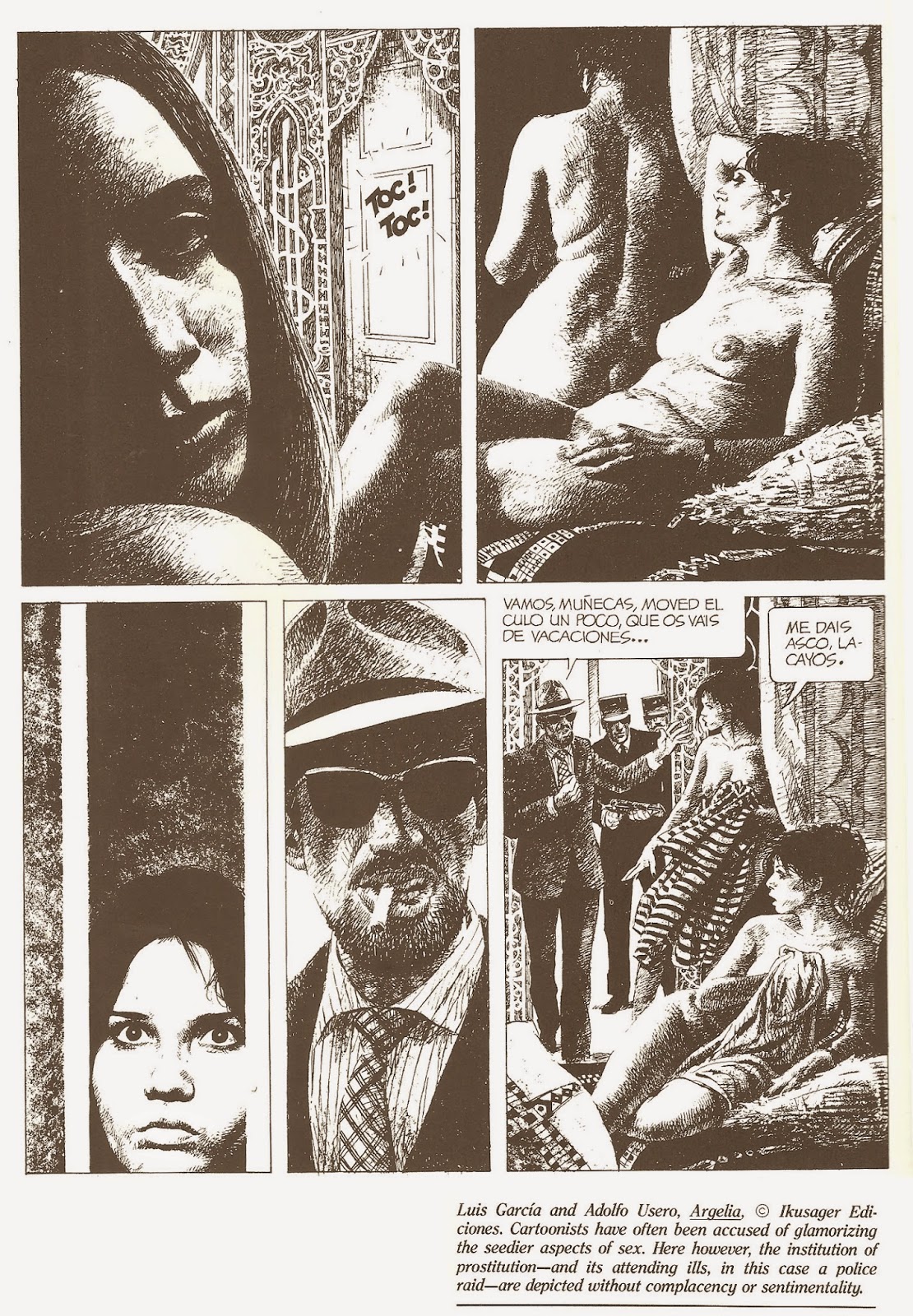
In recent years the motto of the comics might well have been “Anything goes” as far as erotic expression is concerned, with some themes seemingly straight out of Krafft-Ebbing's Psychopathia Sexualis. In fact, cartoonists have proved themselves so thorough in the graphic depiction of every quirk and singularity of human sexual behavior that an enterprising publisher has come out with an Encyclopedia of Sex entirely illustrated with examples culled from comic strips. It would be impossible to go through a checklist of every perversion known to man and see how it found its illustration in the comics, but let us note that whole stories have been built around themes of transvestism (Nazario's Anarcoma, which takes place on the outer fringes of post-Franco Barcelona), pedophilia (Dick Matena's Alice, a less than innocent reinterpretation of Lewis Carroll's tale), incest, (Enric de Sió's sensual Cuestion de Fé, the allegorical Age of Cohabitation by Dôsei Jidai) and necrophilia (Richard Corben's Lame Lem's Love).
Since comics to a certain extent are still beholden to the “funny animal” tradition, the sight of such creatures as Howard the Duck, Cerebus the Aardvark, or the White Ape commingling freely with women is hardly noticed in the context of perversion. Robert Crumb provided an ironic twist on the theme in Whiteman, wherein the protagonist forsook his nagging wife and his middle-class life to pursue his hairy lover, the animallike Yeti, into the wilds. But Whiteman can also be placed squarely—if that's the word—in the great comic strip tradition of A. Mutt, Jiggs, Barney Google and other harassed husbands (see chapter 1). From Mutt and Jeff to Crumb and back, the subject has literally come full circle.

Saturday, September 27, 2014

Sex In the Comics: Sex and Violence

Here's more from a book called Sex in the Comics from 1985 that I got remaindered somewhere. There's little enough text that I may as well retype it in its entirety. The book exists mainly for the images, many of which are blown up much larger than they were originally. Most of the chapters are much dirtier than this one, which mostly covers mainstream comic strips. A big problem with the book (among several) is that many of the examples that were originally in color are not reprinted in color here. Hopefully the hyperlinks that lead you to examples which are will make up for that.

The previous two chapters were posted here and here. Here's the third one written by historian Maurice Horn:

Sex and violence have gone hand in hand since the dawn of mankind. The caveman, it is reported, were not averse to using a little violence in order to get a little sex from the cave women. The bible is full of episodes linking sex with violence, and vice versa, from Judith vamping Holofrenes out of his head to Salome peeling off to get John the Baptist's. Examples drawn from literature and history are so numerous that it would be possible to fill an entire book with them. In fact, so interlocked are sex and violence that they are usually pronounced in the same breath by fire-and-brimstone evangelicals and overzealous PTA mothers: sex and violence, even in sex 'n' violence (sex, it should be noted, always gets top billing—perhaps because it is a shorter word).

In the comics sex and violence—or rather eroticism and adventure, their classier relatives—made their appearance as funnies started moving away from mere humor to action and thrills. Comic-strip artists and their readers seemed to discover with some astonishment that couples could spend time in pursuit other than bickering or hurling at each other—such as going around the world in a plane, fighting for justice or putting down mad potentates. The call of adventure, the thrill of danger, the smell of victory are a heady brew, and they make they blood of hero and heroine alike course faster. Action, especially violent action, is an aphrodisiac. This was all the more striking in the early comic pages, where the comics tried to avoid giving even a hint of sex. But the images of a male and a female in close intimacy, facing some unspeakable peril, spoke for themselves.

In the beginning the world of comic-strip adventure was a world of unquestioned male supremacy. The hero was there to rescue his girl, seldom the other way around. In fact, the fierce exclusiveness of heterosexual bonding was one of the most common motivations for the action. The Phantom was forever saving Diana Palmer (sometimes willy-nilly) from the clutches of rivals. Mandrake eternally getting Narda out of the predicaments she always fell into, and Prince Valiant perennially vying for the favors of Aleta. Only much later did the all-powerful male hero find a female counterpart in the comic pages.

In the jungle, where issues and people alike are stripped down to the bare essentials, the theme emerged with crystal clarity: ”Me Tarzan, you Jane” was a concise, if ungrammatical, statement of the situation. And Jane had to wait, half-naked and helpless, subjected to the whips of sadistic jailers and the whims of jealousy-crazed warrior-queens, until the Lord of the Jungle saw fit to come to her rescue. Similarly, the white African queens and high priestesses Tarzan kept encountering were there to be subjugated, whether through manly force or virile charm, by the male hero.

The situation was not too different in The Phantom. In the very first episode the obscenely fat and libidinous Kabai Singh, chieftan of the dreaded Singh Brotherhood, imforms Diana (clad in a flimsy and revealing outfit) that she is to become one of his harem girls. To teach her a lesson in obedience, he has her suspended over a shark basin, but the Phantom intervenes in the nick of time (natch). Diana spends the remainder of the story in her slave-girl costume, her charms advantageously exposed, as she and her hero gamely face (often in tight embrace) Kabai's minions, finally making their escape from the Singh hideaway. This opening tale set the tone for many of the adventures to follow.

Milton Caniff's Terry and the Pirates wove adult themes into its narratives more often than any other strip of the Depression era. His major female characters as much as male—Pat Ryan, the Dragon Lady, Burma, later Terry himself—displayed an earthy, healthy sexual quality that ran as an undercurrent through their adventures. The love-hate relationship between Pat and the Dragon Lady is significant in this respect: they were thrown in the countless perils together, sometimes as allies, often as foes, and their intimacy acted as an aphrodisiac, even though they might return to an antagonistic relationship afterwards.

Nowhere were sex and violence as intertwined as in Terry. The sexual situations constantly shifted with the ebb and flow of the action: the couples in this strip were always forming, dissolving, and re-forming in endless combinations. Sexual triangles abounded (Caniff's characters were seldom models of fidelity): Dragon Lady/Pat/Burma. Pat/Burma/Terry, April Kane/Terry/Dragon Lady, and all the permutations allowed by the vital flow of the narrative. There were all physically attractive characters, and with the ever-present threat of danger hanging over them, the attraction was heightened and quite naturally strongest between those who happened to be closest together at any given moment.

The same adult outlook carried over to Caniff's Steve Canyon, at least until the hero unfortunately got married (heroes never marry, as Hercules and Samson learned to their sorrow). In addition, the violence took on explicitly sexual overtones: in one adventure a voluptuous blonde is exposed (in more ways than one) to the threat of being branded with a red-hot iron. Scenes of sexual torture and bondage occur often in this long-lasting strip, almost as a matter of course.

The concept of male dominance in the field of adventure took its knock with Sheena, Queen of the Jungle. As Juanita Coulson described her in The Comic Book Book, Sheena would swing through the pages of Tarzan-style, her long, blonde hair flying an fur bikini plastered to her 42-22-34 figure. I'm sure it brought the drooling male male readers back for more.” Sheena had a male companion named Bob constantly in tow, and she was always busy saving him. But I suspect that she got her thrills more from tussling with strong-bodied male antagonists than from mooning with her cardboard lover.

The jungle-queen theme was later expanded and made even more explicit in the Mexican comic book ,Roratonga. The beautiful title character is described as a green-eyed, light-skinned mulatta who holds sway over her male counterparts in an unmistakably sexual fashion.

The threat of danger or violence acting as a prelude or a fillip to sexual activity emerges more clearly in Modesty Blaise, in which the heroine and her faithful male assistant, Willie Garvin, obviously enjoy a relationship made even more intimate by the requirements of action and suspense. Here are the male and female roles, while still firmly delineated (most of the heavy violence is left to Willie), come closer to a position of parity (indeed, it is Willie who occupies the subordinate role).

Modesty is British and even in the heat of action tends to preserve a modicum of quality for which she is named. The Italian heroines are not so reserved in their proclivities and activities. Bearing evocative names—Jungla, Jacula, Angelia, Lucifera—and scant costumes (if clothed at all), they freely mix the games of sex with those of violence in close encounters of any kind.

When the first detective of the comics, Dick Tracy, arrived on the scene in 1931, suspenseful, violent, often brutal action arrived with him. The focus of the violence has often been Tracy's girlfriend (and later wife) Tess Trueheart, and this has given an obvious sexual undertone to the goings-on. It was to avenge the murder of Tess's father that Tracy joined the force, and it was because of Tess that he went through some of his most harrowing ordeals. Tess has been the frequent object of violence on the part of sadistic criminals trying to take revenge on her mate or to trap him. Violence, often prompted by strong sexual motivations, has been visited upon many of the strip's other female characters as well.

Sexual jealousy also proved a strong motive in Secret Agent X-9, especially during the short time that Dashiell Hammett was writing the strip and Alex Raymond drawing it. Two-timing, two-faced dames were a staple, as were the acts of violence they either committed or provoked—they were not above trying to seduce him or scratching out the eyes of their rivals. Later, when Raymond went on to create Rip Kirby, this theme acquired a more polished, committed, upper-class tone in the form of crime passionel committed by the rich and famous. Meanwhile, Austin Briggs, who inherited X-9, continued the tradition with his gallery of alluring Mata Haris and slinky femmes fatales who would resort to any amount of physical violence when enticement failed to achieve their ends.

The tradition was further carried on, often tongue-in-cheek, in Will Eisner's The Spirit. A multitude of homicidal sirens were always crossing the Spirit's path, from the much married (and often widowed) Silk Satin to the sultry P'Gell, and our hero never tired of tussling with them. Later on the Spirit became kind of an emcee or umpire—he enjoyed the sex while others indulged in the violence. Along with his creator the Spirit had grown older, and wiser in the ways of the world.

Latter-day gumshoes became even more outspoken in their attitude toward the twin (and fatal) attractions of violence of violence and sex. In the Mike Hammer strip Mickey Spillane, who wrote the scripts himself, hardly toned in his hero's “bash 'em or bed 'em” method of detection, to the despair of his syndicate editor, Jerry Iger. Despite its success the strip was continued because of his outcries from critics during the squeamish fifties. Later, during the more liberated seventies, Wallace Wood brought out Cannon, a private-eye strip even more openly brutal and explicitly erotic than Hammer, nobody batted an eye.

In the late forties and early fifties the comic-book industry developed its own end o sex-explicit police titles. These often featured overendowed female sleuths, such as Phantom Lady and the Black Cat (a master of karate), who were then thrown into dangerous and revealing situations. Along with the horror comics, these crime comic books aroused the particular ire of the censors, who liked to point to the exaggerated anatomy of the female protagonists (“headlights”) and a pernicious influence on young readers.

For sheer imprudence, however, nobody can rival the Italian comic strip writers and artists. For instance, Diabolik, created by the sisters Angela and Luciana Giussani, has been featuring the bloody exploits of a master criminal for over twenty years. All through that period Diabolik and his beautiful companion in crime, Eva Kant, have been mixing sex and gore in almost equal amounts. The success of Diabolik has given rise to a host of imitators—Kriminal,Fantax, Demoniak, Sadik (sic)—each more sexually violent and more violently sexual than the last. In this domain, it should be noted, the Mexicans run the Italians as a close second with such superheated features as Fantomas,Arrabalera, and Sirenia.

The violent trend in American comics were exacerbated by the coming of World War II. The saying “All's fair in love and war” was soon transformed into “Anything goes” in the wartime comics. It was then that Dick Tracy featured a particularly sadistic episode, ”The Case of the Brow”, in which espionage, mayhem, torture and sexual bondage were all mixed up together and served hot. In Terry, Burma and the Dragon Lady both used their feminine wiles to lure the hated Japanese into deadly traps, while Captain Easy and Barney Baxter were kept busy saving innocent blonde American nurses from rape, torture, and death at the hands of their buck-toothed Japanese captors. In the European theater of war, secret agent Vic Jordan used beautiful resistance fighters as bait for sadistic SS guards and Gestapo henchmen.

The epitome of the war syndrome in comics was perhaps Black Fury (later Miss Fury). Miss Fury was in civilian life beautiful socialite Marla Drake, who donned a block leotard to fight for Justice and the American Way. Her adventures, already tough from the outset, became literally hard-boiled with the onslaught of the war. There were no holds barred in the heroine's battle against Nazi agents and their American accomplices. Females battling each other tooth and claw were staples, as were men savagely beating up on women, and the use of whips, branding irons, and other implements of torture.

The comic books particularly warmed to the theme as they discovered they could depict any amount of sex and gore as long as they kept the proceedings patriotic. This was a time when a costumed hero with the no-nonsense name Spy Smasher could beat the Dark Angel, an enemy villainess, into submission without too many questions asked. Nor was anyone perturbed by depictions of savage beatings or torture inflicted on helpless female prisoners or hostages by grinning Japs or monocled Nazis in such patriotic comic books as Captain America,Minute Man, and the aptly named Military Comics.

Many of the comic-book warriors were aviators, which gave them wide latitude to roam at will from one theater of war to another. Among them were the Blackhawks,Captain Wings, Captain Midnight and many others of the same ilk. They all featured incredibly violent action and displayed incredible amounts of female flesh. They also offered scenes of the heroes locked in deadly physical combat with women adversaries. The best example is perhaps Airboy, who fought a string of battles, aerial and otherwise, with the ruthless German female air ace Valkyrie and her squadrons of sexy Air Maidens. Aside from being an unconscious (and quite effective) Wagnerian pastiche, the Airboy comic books contained unbridled tableaux of sadistic violence (women being mercilessly whipped, Valkyrie slowly torturing Airboy, etc.).

All this went on without a murmur from the self-appointed guardians of morality. As Pauline Kael wrote in a later review of the 1945 movie Confidential Agent, “Those unfamiliar with the melodramas of the forties may be shocked at the brutalities that sneaked by under cover of the anti-Fascist theme.” Which goes to show that the violence in these comic books was a phenomenon of the time more than a flaw inherent in the medium, as later detractors would try to prove. More recent conflicts, such as Korea and Vietnam, did not arouse the same popular fervor, and thus did not provoke a corresponding level of violence in the comics of the periods, Steve Canyon to the contrary. After 1945, war—except World War II, which was still being fought in some comic books as late as the seventies—seems to have lost most of its sex appeal.

In the comics women have most often appeared (in men's eyes) as threats or victims—either terrifying Medusas or willing Justines. This is a world that is still divided into “good girls” and “bad women”, just as it is still largely divided into “bad guys” and “heroes”. Yet in the comics the division is mot so rigid that it doesn't allow some movement from one sphere to the other. One of the clichés of the medium, as of all popular literature and movies, is that of the “bad woman” not only reforming but protecting the hero at the cost of her own life. This theme is particularly evident in many of the crime strips (Secret Agent X-9, Red Barry, Cannon, etc.) The woman's earlier hostility towards the incorruptible hero thus stands revealed as the measure of her sexual frustration.

Of course, the more hard-boiled dames harbor to no such qualms. They do not hesitate to play out their characters in full by trying to do in the hated male (The “Hell hath no fury...” syndrome) in a variety of ways, always in vain, as it turns out. Examples of this kind of behavior (deplorable or admirable, depending on the viewpoint) abound in comic strips as well as in comic books. It can be found in The Phantom, in Inspector Wade, in Daredevil, even in Batman, sometimes taken to extremes, as in those not infrequent cases where the villainess tried to take the hero's life along with her own. That's what may be called vengeance with a vengeance.

Examples of openly sexual violence, as distinct from sexually motivated acts of revenge, were rare in the early comics (except during World War II, when they masqueraded as acts of patriotism, as we have seen). The situation has changed drastically over the past two decades: not only have literary works of sadism been adapted into comics form Sade's Justine and Juliette, among others, but sexual cruelty has emerged as one of the major “adult” themes of the medium.

In our culture rape is considered to be the primary symbol of sexual violence, which may be why the comics long shied away from its depiction, or even its mention (fear of words is the puritan's obsession, as Sartre observed). Graphic intimations of rape were not uncommon in such strips as Rip Kirby, Smilin' Jack, Mandrake, and others: One scene in Skyroads, for instance, shows a repulsive, hunchbacked dwarf dragging a young woman away by her long blonde hair. But the act itself never consummated, or even initiated: the hero always managed to get there in time and save the beauty from the clutches of the beast. Only recently has rape (even homosexual rape) been depicted in graphic terms.

The question of sex and violence in the comics has always been a touchy one. This was the issue that prompted Dr. Frederic Wertham's attack on the medium in Seduction of the Innocent and caused the long period of ostracism and censorship that followed. Ever since those dark times in the fifties, comics fans have lived in fear of another anticomics crusade, and they have watched with apprehension (as well as furtive enjoyment) the rise of nudity, sexuality, violence, and other formerly taboo subjects in the comics. Their fears seem to be largely unfounded. The comics have only belatedly caught up with the trend apparent in other media, notably television. Times have changed, and the comics have changed with them, gradually becoming a more mature medium, in readership as well as in concerns. There is no way the clock can now be turned back.
A lot of the illustrations have no accompanying text, which wasn't the selling point of the book anyway.

Thursday, August 7, 2014

Comics: No blog complete without them

People seem to like the classic strips more than when I find someone older more obscure ephemera. I'm back with more excerpts from Comic Art in America, a history of the medium from 1959, so therefore stops at that point.

The book is mostly text but is illustrated profusely with the strips they're talking about. Herewith are those strips with captions underneath which say:

Enter Steve Canyon. Suspense was created in the very first Sunday page, on January 19, 1947.

Like I said when reprinting some reprinting some strips last week, Steve Canyon was something Milton Caniff created when he lost the rights to Terry and the Pirates.
The Sunday Steve Canyon of November 18, 1956, a high point in verbal and visual wit. The strip of tape in the last panel is a superb touch.

Unlike most of the strips that were taken from newspapers, you can tell this was taken from the original by some of the images going out of the margins.
BILL HOLMAN's panel Nuts and Jolts. Notary Sojac creeps in even here.
A Sunday Smokey Stover, by BILL HOLMAN, 1952. The puns are as outlandish as ever, and so are the characters.
Another Smokey Stover, HOLMAN's invention never flags. The man has been perpetrating these outrages for a quarter-century.
Slats Scrapple in action. By RAEBURN VAN BUREN.


The book doesn't say so, but this is from Abbie 'n' Slats.
Action and fine draughtsmanship in this NOEL SICKLES strip of Scorchy Smith. Sickles' influence on his contemporaries—e. g. on close friend Milton Caniff—is obvious.
A daily Chief Wahoo of January 1941 showing Wahoo with Steve Roper as he looked in those days.
Steve Roper, 1959. Long shot; close-up; medium close-up; slick chick and handsome hero.
A Sunday Mary Worth. Apple Mary has risen from the slums to the height of modernity and fashion. ALLEN SAUNDERS' continuity is sophisticated and KEN ERNST's drawing is in the best illustrator's style.
.
CARL ANDERSON's Henry. This was done three years after Anderson's death, though signed with his name. Henry hasn't changed a bit.
Nancy once more. ERNIE BUSHMILLER's strip is one of the half-dozen most popular strips in the world.
The Gumps again—GUS EDSON's Christmas strip, 1939. Andy, Bim, and Tilda are as homely as ever, but Min has become a bit prettier.
A daily Dondi, created by GUS EDSON and IRWIN HASEN in the aftermath of the [Korean] war. Its circulation has risen steadily.


I had Hasen as a cartooning teacher at the School of Visual Arts. As far as I know, he is still alive at 97.