Showing posts with label R. CRUMB. Show all posts

Saturday, October 18, 2014

Satirical Sex

Here's another chapter, like previous Saturdays, I've taken from Sex In the Comics, a book from 1985 I found remaindered a few years ago. More about the book is mentioned in previous installments that can be found in the archives, and as usual, I don't agree with all the text by Maurice Horn.

TRIGGER WARNING: This section may contain information about sexual assault and/or violence which may be triggering to survivors.

I think that's what I'm supposed to do. I don't think any laws should be passed. It's just something an author should do out of courtesy. I don't understand how mentioning a trigger doesn't set off a trigger itself. I'm mainly posting this for the pictures anyway. Here's this chapter of the book for you to enjoy 98% of.

To comic artists nothing is sacred, not even the sacred—or the taboo. It was inevitable, sooner or later, that sex would come in for the same kind of treatment that had already laid waste (in the funny pages, at any rate) such sacrosanct American ideas such as the family, he natural goodness of mankind and the work ethic. This brand of humor is part of the American tradition, going back to minstrel shows and burlesque, of viewing sex as a primarily laughable human proclivity. It evokes the world of the dirty joke, the double entendre, the innuendo, the leering pun and all the other bawdy routines associated with what Preston Sturges (no slouch himself when it comes to sexual satire) liked to call “subject A”

Among newspaper artists Al Capp is probably the best representative of this long-standing though hardly hallowed tradition. In Li'l Abner he stood sex on its head, picturing most of his female characters as oversexed and eagerly in pursuit of the unwilling, harassed men—a common male fantasy, it should be noted. To embody his basic premise, Capp created a handsome, uninterested hillbilly (first Li'l Abner himself, later his kid brother Tiny) warily fending off hordes of sex-hungry females, of whom Daisy Mae was the most persistent, Li'l Abner's philosophy of life was expressed early in this piece of doggerel: “Oh—ah'm glad ah is a bacheluh!/ Ah'm young'n'spry an' free!/Hain't nevah getting' married!/ No gal kin bother me!”

To test his ideals Li'l Abner was put through temptations not unworthy of St. Anthony. When a smoldering high-society dame, the wonderfully named Appassionata von Climax, tried to seduce the hero by wining and dining him and showering him with gifts, Li'l Abner's response was to ask for more and more food, and to take longer and longer naps on increasingly sumptuous beds.

In one adventure Li'l Abner journeyed down to the misnamed republic of El Passionato, where the male citizens were so indolent that our hero looked like a sex bomb in comparison. Accordingly all the luscious Latin beauties were soon swooning over the “foreener”. In desperation Li'l Abner made himself dictator and forced all the men to breathe the dread “Goombo”, which turned them into raving sex maniacs, which in turn prompted them to lose interest in Abner.

In another episode Tiny's love-light, the amply endowed Marcia Perkins could not kiss because her lips gave off 451 degrees of electromagnetic heat, enough to fry any boy's brain. The solution was to have her kiss Li'l Abner whose lips registered 451 degrees below zero, thus canceling her temperature out. In a fitting conclusion Tiny broke with Marcia on the grounds that she kissed another man.

The apex of all this tomfoolery was of course reached every year on Sadie Hawkins Day. That fateful day any girl able to catch one of the fast-fleeing males got to marry him. And that, in Al's mad-Capp world, was as fiendish a fate as could be devised.

Later Capp simply reversed the premise in Long Sam, which was drawn by Bob Lubbers. Sam was an incredibly endowed, naïve hillbilly girl who became the innocent object of every leering, panting male around. The theme was too familiar, however, too close to the sexual situation prevailing in real life, and most of the fantasy was lost.
Milton Caniff, who had honed his sexual wit on Terry and the Pirates, proved a master of innuendo in Male Call. His heroine, Miss Lace, an appetizing brunette, flirted outrageously with every soldier, sailor, and airboy she met, and they in turn were forever drooling over her. This simple theme, seemingly so trite in normal life, proved irresistible to readers of Stars and Stripes, the military paper for which the feature was created. Caniff was cunning enough to know that to a sex-starved buck private out in the field, the mere sight of a girl was fantasy enough.

Caniff's gag technique was almost always the same. In the first panels of the strip he would set up a basic situation that often as not hinted at sex, intercourse or worse, only to deflate it in the last panel. Thus Lace would finally give in to a soldier's insistent entreaties, but after he removed his uniform we'd learn she just agreed to sew a button back on. Or she would closely clasp a soldier in her arms, but only so he could demonstrate a judo grip to her. In one strip Lace woke up with a sleeping form in bed next to her and an officer's jacket spread out over a nearby chair; the bedmate turned out to be a WAC. The implications proved to be too much for the straightlaced editors of Stars and Stripes, who censored the offending strip. These World War II strips still retain enough charm that collections of them have been regularly reprinted over the years.

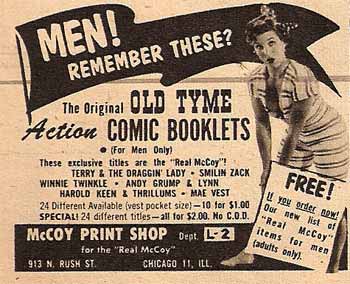
At the same time that the sexual humor cautiously surfaced in newspaper strips, a host of anonymous cartoonists were spoofing sexual themes much more explicitly in a variety of black-and-white comic books, “the kind men like”, as their promoters advertised with a leer. Dubbed “eight-pagers” or ”Tijuana Bibles” (though most of them were actually produced in Cuba), they were four-by-six inch booklets that lost no time in telling their story, which always dealt with the sexual activities of either public figures (most often movie stars, gangsters, and politicians) or comic strip characters.

The first type, eight-pagers about public figures, seems to have been the earliest. They flourished during the depths of the Great Depression and, reflecting their times, often mixed sly social commentary with unabashed sexual satire. One of these early eight-pagers (titled “A Hasty Exit”, and typical of many) depicts notorious outlaw John Dillinger engaged in sexual activity with two girls when the law, in the person of one Captain Tracy, pounces upon him. Dillinger thereupon invites the cop to share in the fun in exchange for his freedom. A general frolic ensues after Tracy phones headquarters to tell them that the fugitive has escaped over the border. The subversive message was carried further in several other booklets that showed gangsters taking the rich (and usually bankers' and politicians' wives whom they had first seduced) to give to the poor (for instance, some out-of-work shopgirl or secretary they'd picked up on a park bench).
Whatever their merit, the public-figure satires were greatly outnumbered by the comic-strip parodies. Every prominent comic character was fair game for the cartoonists of the eight-pagers—not only such supposedly virile late heroines as Jane Arden and Little Orphan Annie, and even week little wimps like Mac of Tillie the Toiler and Pete the Tramp. All the readers' fantasies about the private lives of their favorite funny-page heroes came through in these little booklets. Thus we find Popeye making it with Olive Oyl, Dick Tracy shooting Junior in the head for interrupting his coitus with Tess, and Clark Kent/Superman finally bedding Lois Lane—who promptly sends him away in disgust (the oversexed superhero was a cliché even then).

As a matter of fact, the comic parodies came out so fast and in such profusion that the best-known characters soon found themselves “played out” and minor characters of obscure strips or protagonists of obscure strips had to be pressed into service. In one of the comic booklets Walter Hoban's Needlenose Noonan, a cop, answers a call only to find help only to find a sex-hungry mountain woman waiting for him in the buff. Losing no time in preliminaries, she proceeds to undress the hapless Noonan and use every last part of his body—including the one that earned him his nickname—to satisfy her cravings.
By the end of the forties the eight-pagers had become tired and repetitive, every character and every situation had been milked to the fullest, and there were few sexual variations left to explore. The booklets finally petered out in the fifties (when cheap and heavily censored versions were advertised through the mails, in contrast to the real items, which were generally sold under the counter). When the more permissive era of the sixties opened up new fields for the graphic depiction of sex, they sinply became objects of curiosity and even nostalgia.

It is easy now to snicker at the crudeness and single-mindedness of the “dirty comics”, but as Bill Blackbeard (writing under the transparent pseudonym “William Teach”) says, “Of course, sex depicted in the old comic booklets was crude and forced, just as slapstick could be forced in the legitimate strips...But this excess is largely the result of the equally crude and forced repression of the most minimally frank handling of sex in the general comic strip.”
The eight-pagers, with their raunchy humor and unfettered une of established cartoon characters, found modern-day more sophisticated counterparts in the “underground comix.” Cartoonist Dan O'Neill achieved perhaps the ultimate in sexual parody by having Mickey Mouse and his beloved Minnie perform a well-publicized sex act. The Disney people were not amused and promptly sued for lèse-majesté (the actual charge was copyright infringement), a case they eventually won.

Another undergrounder, Gilbert Shelton, satirized Superman with no repercussions in his Wonder Wart-Hog comic strip. In his civilian identity—Philbert Desanex was a meek, much put-upon reporter—an obvious dig at Superman's alter ego, Clark Kent—but when he donned his costume, the “Hog of Steel” did not confine his exploits to the destruction of evildoers. His prowess also extended to the sexual field, where he liked to make use of every part of his anatomy, including the celebrated snout.
In the early days of his career Richard Corben (under the pseudonym “Gore”) also enjoyed doing sexual satires, but his always had a sharp edge to them. In ”Dumb Story” earthmen bring so-called morality and civilization to a guilt-free and sexually contented race of extraterrestrials whom they destroy. ”Horrible Harvey's House” concerns a porno star jaded with the blandishments of sex. After acting in yet another skin flick, she is raped in her sleep by a horrible creature who awakens in her stirring he thought she had forgotten. She eventually abandons her director boyfriend to pair up with her newfound love. In both tales the undertone of bitterness at human weakness and human folly is unmistakable and can not easily be dismissed.
The concept of sex itself got a working over in Denis Kitchen's Ingrid the Bitch. This five-year-old nymphet disdained the usual comic-book heroes including the inevitable Superman) in favor of her faithful and no less libidinous canine companion. Pooch.

With Young Lust (an obvious takeoff on Young Love), an underground comic edited sporadically over the years, Bill Griffith and Jay Kinney set out to parody an entire genre, that of romance comics—an easy target, admittedly. Their Method was to take the concept to its most outré limits (and beyond). Two examples should suffice. In ”Plug Un-Plug” by Griffith, the lead character fantasizes his love life, which includes a hilarious would-be rescue of Jayne Mansfield from a shipwreck. In “Under the Covers” Jay Kinney and Paul Mavrides mix the clichés of romance stories with the conventions of the spy-thriller genre in a tale of the love between the two CIA agents, one of whom turns out to be a KGB mole.
The undergrounders, like their eight-pager predecessors, also like to produce well-known-politicians (usually their perceived enemies on the right) in kinky situations, showing them as basically beastly, dishonest and hypocritical Richard Nixon particularly came in for the heaviest share of the underground cartoonists, who never tired of portraying him as “Pricky Dick”, “Creepy Dick”, and worse.
As the widely acknowledged “pope” of the underground, Robert Crumb has been at the forefront of the sexual revolution in comics. Even his early Fritz the Cat strips displayed a playful understanding of sex: under his animal guise his character behaved pretty much like a normal sex-driven human, playing out his role of cat-about-town with the expected bravado. In one episode the sly fellow dazzled his date with the high-flown rhetoric about the meaning of life while imperceptibly but surely leading her into bed. In another story he managed to turn a sex orgy in a bathtub into a transcendental group encounter.

Crumb had a keen ear for the cant that pervaded much of the sexual revolution of the sixties, as well as a sharp eye for its more egregious lunacies. He was very much in time with his time but could also revert with a wink to the practices of an earlier, more repressed era, using a blackout technique that stopped just short of the depiction of the sex act. At one point, for instance, Fritz elaborately undresses a demure kitten in order to pick fleas off her body.
Later, moving from funny animals to funny humans, Crumb liked to depict children of nature innocently engaging in sex and unashamedly enjoying its pleasure. One such was Angelfood McSpade, an African Amazon of gargantuan sexual appetites, who would willingly submit herself to any male she chanced to encounter. Ironically, Angelfood, introduced to Western civilization, promptly had her hair and skin bleached, turning herself into one more version of the average middle-class housewife, to the disgust of her male partners. Another unabashed hero of the same ilk was Dicknose (Crumb's names for his characters were nothing if not descriptive), who somehow managed to get his proboscis into the most compromising spots. Crumb's earth children were contrasted with Whiteman, a typically repressed product of Western Hypocrisy, greed, and power lust.

Some of Crumb's comic book badinage was so inhibited as to bring prosecution down upon the artist's head. Joe Brancatelli wrote in World Encyclopedia of Comics “Crumb's work was shockingly explicit for the late 1960's. Each and every story centered around lovemaking, or kinky variations of it.” In mock contrition Crumb would self-deprecatingly sign his more ribald pages “R.Scum” or “Crumbum” or “El Crummo”, which of course only called attention to the outrageousness.
Crumb and his wife, cartoonist Aline Kominsky (whom he'd earlier depicted as “Honeybunch”) have been of late publishing comic book diaries, If anything, Crumb's confessions prove that he has steadfastly remained true to himself. They are remarkably candid, as well as excruciatingly funny, in the depiction of more aspects of conjugal life. As one critic put it, Crumb “can make even married sex look like fun”.

At a casual glance, the world of the underground cartoonists does not seem too far removed from the raunchy preserves of the eight-pagers. The difference lies in the artistic integrity the undergrounders brought to their work, however limited the artistic talent of some of them. Indeed, Crumb enjoyed the rare distinction of having his comix ruled works of art by a court of law, which acquitted him of obscenity charges on precisely those grounds.
Wally Wood, whose works include the now famous poster of Snow White sexually molested by the Seven Dwarves, has also made a not inconsiderable contribution to the farcical treatment of “Subject A”, much in the manner of a Sturges or a Blake Edwards. His stylish exercises in this vein extend all the way from his wild comic strip parodies in Mad magazine to such seventies frolics as The Pipsqueak Papers (a charming skit about a tiny homunculus tricking the standoffish nymph he pursues into lovemaking) and his wholly uncanonical treatment of Alice in Wonderland. In these slight tales Wood has proved he can be a master of the quiet wit as well as frenzied satire.

Wood's longest-running feature was Sally Forth, a comic strip he did in the late 60s and early 70s for the servicemen's publication Overseas Weekly (not to be confused with the Sally Forth strip currently in American newspapers). Sally Forth shows just how far the army has come since the days of Male Call (“The New Army wants to join You,” indeed). While there is still no full frontal nudity and explicit lovemaking is only hinted at, much high-spirited manhandling goes on in the strip, and implicitly sexual situations abound. In particular the tug-of-war on the steps of the Pentagon pitting the nude Sally and her equally naked cohorts against U.S. Soldiers in full-dress uniforms (shades of battle between the Amazons and the Acheans!) is certainly more than a little suggestive. Wood's flexible drawing style is particularly suited to representing action hovering midway between tongue-in-cheek fantasy and straight narrative.
It fell to another Mad alumnus, Harvey Kurtzman, to achieve in Playboy magazine what is probably the most widely known of all the good old-fashioned comic-page parodies. Little Annie Fanny. As the title suggests, is an obvious takeoff on the old Little Orphan Annie newspaper strip. The title character is a ridiculously well-endowed blonde ingenue whose obliviousness to men's lewd advances constitutes the main theme of the feature. The supporting cast includes Annie's well-heeled protecter Sugardaddy Bigbucks (modeled on Daddy Warbucks, of course), her peppy girlfriend Wanda Homefree, and Solly Brass (a Phil Silvers clone), her scheming, loudmouthed, press agent.

So far Annie Fanny has managed to retain her innocence amid all the shenanigans, though Wanda has come in for her share of fun (mostly offstage). The bawdy humor, for all its outrageousness, seems a bit forced at times. However, Kurtzman makes up for it in some pointed social and political satire, at the expense of such targets as industrial tycoons, power-mad generals, right-wing politicos, TV network executives and the NAS space program. The artwork is for the most part contributed by Will Elder, yet another Mad graduate, whose lush style and creamy colors are well suited to this erotic version of Candide.
The success of Annie Fanny in Playboy prompted other men's magazines to follow suit, Pretty soon they were all carrying comic strips of varying quality. The best of these was undoubtedly Oh, Wicked Wanda, which British artist Ron Embleton created for Penthouse on scripts by Frederic Mullally. Wanda was a voluptuous brunette whose charms were very much in view most of the time. There was none of the coyness exhibited in Annie Fanny; Wanda went the rounds like someone who knew the score. She never lost her cool, even when thrown in a dungeon by a jealous rival or on the verge of being executed as a spy by shifty Eastern European types.

Wanda's adventures were humorous rather than satirical, filled with peril and sexual shenanigans. Nudity was freely depicted, and there was no dearth of explicit sexual situations. Withal the strip was roguishly charming rather than scabrous. Mullaly's tongue-in-cheek writing certainly helped, but the major credit belongs to Embleton, whose elegant brushwork endowed Wanda not only with allure but with more than a touch of class as well. Embleton now draws another strip for Penthouse, Sweet Chastity (on texts by Bob Guccione himself), about Baron von Frankenstein's creation of the “perfect woman” and her epochal struggle with the baron's power-crazed daughter, the aptly named Electra.
Though they have been extremely prolific in other types of sex comics, Europeans have seldom achieved a truly satirical treatment of the subject. One notable exception is Georges Pichard, who imparts a good dose of humor to even his most outrageous narratives, His first essay in the genre was Blanche Epiphanie, a parody of turn-of-the-century dime novels, in which the much-undressed heroine was much on the verge of being raped by the libidinous banker Adolphus, only to be saved in the nick of time by a masked avenger.. This was followed by Paulette, about a wealthy and comely heiress who went through all sorts of harrowing ordeals (of which rape was the least objectionable).
Pichard sounded much the same theme in Caroline Choléra—with an interesting twist, however:Caroline experienced the whole gamut of kinky sex out of sheer feminine curiosity. When she judged that enough was enough, she would turn on her aggressors with a vengeance. In one episode, for instance, she was captured by “birdmen”, who subjected her to a thorough inspection to determine what species of bird she was. From the brown circular spot on her rump they concluded she must be a Canadian goose. Upon hearing herself be called a goose, Caroline, who up to then had endured all other indignities with a casual air, jumped to her feet I a rage, sending her tormentors scurrying for cover.
Thus have today's cartoonists killed two birds with one stone, by bringing sex into the comics without taking comedy out of sex.

Saturday, September 27, 2014

Sex In the Comics: Sex and Violence

Here's more from a book called Sex in the Comics from 1985 that I got remaindered somewhere. There's little enough text that I may as well retype it in its entirety. The book exists mainly for the images, many of which are blown up much larger than they were originally. Most of the chapters are much dirtier than this one, which mostly covers mainstream comic strips. A big problem with the book (among several) is that many of the examples that were originally in color are not reprinted in color here. Hopefully the hyperlinks that lead you to examples which are will make up for that.

The previous two chapters were posted here and here. Here's the third one written by historian Maurice Horn:

Sex and violence have gone hand in hand since the dawn of mankind. The caveman, it is reported, were not averse to using a little violence in order to get a little sex from the cave women. The bible is full of episodes linking sex with violence, and vice versa, from Judith vamping Holofrenes out of his head to Salome peeling off to get John the Baptist's. Examples drawn from literature and history are so numerous that it would be possible to fill an entire book with them. In fact, so interlocked are sex and violence that they are usually pronounced in the same breath by fire-and-brimstone evangelicals and overzealous PTA mothers: sex and violence, even in sex 'n' violence (sex, it should be noted, always gets top billing—perhaps because it is a shorter word).

In the comics sex and violence—or rather eroticism and adventure, their classier relatives—made their appearance as funnies started moving away from mere humor to action and thrills. Comic-strip artists and their readers seemed to discover with some astonishment that couples could spend time in pursuit other than bickering or hurling at each other—such as going around the world in a plane, fighting for justice or putting down mad potentates. The call of adventure, the thrill of danger, the smell of victory are a heady brew, and they make they blood of hero and heroine alike course faster. Action, especially violent action, is an aphrodisiac. This was all the more striking in the early comic pages, where the comics tried to avoid giving even a hint of sex. But the images of a male and a female in close intimacy, facing some unspeakable peril, spoke for themselves.

In the beginning the world of comic-strip adventure was a world of unquestioned male supremacy. The hero was there to rescue his girl, seldom the other way around. In fact, the fierce exclusiveness of heterosexual bonding was one of the most common motivations for the action. The Phantom was forever saving Diana Palmer (sometimes willy-nilly) from the clutches of rivals. Mandrake eternally getting Narda out of the predicaments she always fell into, and Prince Valiant perennially vying for the favors of Aleta. Only much later did the all-powerful male hero find a female counterpart in the comic pages.

In the jungle, where issues and people alike are stripped down to the bare essentials, the theme emerged with crystal clarity: ”Me Tarzan, you Jane” was a concise, if ungrammatical, statement of the situation. And Jane had to wait, half-naked and helpless, subjected to the whips of sadistic jailers and the whims of jealousy-crazed warrior-queens, until the Lord of the Jungle saw fit to come to her rescue. Similarly, the white African queens and high priestesses Tarzan kept encountering were there to be subjugated, whether through manly force or virile charm, by the male hero.

The situation was not too different in The Phantom. In the very first episode the obscenely fat and libidinous Kabai Singh, chieftan of the dreaded Singh Brotherhood, imforms Diana (clad in a flimsy and revealing outfit) that she is to become one of his harem girls. To teach her a lesson in obedience, he has her suspended over a shark basin, but the Phantom intervenes in the nick of time (natch). Diana spends the remainder of the story in her slave-girl costume, her charms advantageously exposed, as she and her hero gamely face (often in tight embrace) Kabai's minions, finally making their escape from the Singh hideaway. This opening tale set the tone for many of the adventures to follow.

Milton Caniff's Terry and the Pirates wove adult themes into its narratives more often than any other strip of the Depression era. His major female characters as much as male—Pat Ryan, the Dragon Lady, Burma, later Terry himself—displayed an earthy, healthy sexual quality that ran as an undercurrent through their adventures. The love-hate relationship between Pat and the Dragon Lady is significant in this respect: they were thrown in the countless perils together, sometimes as allies, often as foes, and their intimacy acted as an aphrodisiac, even though they might return to an antagonistic relationship afterwards.

Nowhere were sex and violence as intertwined as in Terry. The sexual situations constantly shifted with the ebb and flow of the action: the couples in this strip were always forming, dissolving, and re-forming in endless combinations. Sexual triangles abounded (Caniff's characters were seldom models of fidelity): Dragon Lady/Pat/Burma. Pat/Burma/Terry, April Kane/Terry/Dragon Lady, and all the permutations allowed by the vital flow of the narrative. There were all physically attractive characters, and with the ever-present threat of danger hanging over them, the attraction was heightened and quite naturally strongest between those who happened to be closest together at any given moment.

The same adult outlook carried over to Caniff's Steve Canyon, at least until the hero unfortunately got married (heroes never marry, as Hercules and Samson learned to their sorrow). In addition, the violence took on explicitly sexual overtones: in one adventure a voluptuous blonde is exposed (in more ways than one) to the threat of being branded with a red-hot iron. Scenes of sexual torture and bondage occur often in this long-lasting strip, almost as a matter of course.

The concept of male dominance in the field of adventure took its knock with Sheena, Queen of the Jungle. As Juanita Coulson described her in The Comic Book Book, Sheena would swing through the pages of Tarzan-style, her long, blonde hair flying an fur bikini plastered to her 42-22-34 figure. I'm sure it brought the drooling male male readers back for more.” Sheena had a male companion named Bob constantly in tow, and she was always busy saving him. But I suspect that she got her thrills more from tussling with strong-bodied male antagonists than from mooning with her cardboard lover.

The jungle-queen theme was later expanded and made even more explicit in the Mexican comic book ,Roratonga. The beautiful title character is described as a green-eyed, light-skinned mulatta who holds sway over her male counterparts in an unmistakably sexual fashion.

The threat of danger or violence acting as a prelude or a fillip to sexual activity emerges more clearly in Modesty Blaise, in which the heroine and her faithful male assistant, Willie Garvin, obviously enjoy a relationship made even more intimate by the requirements of action and suspense. Here are the male and female roles, while still firmly delineated (most of the heavy violence is left to Willie), come closer to a position of parity (indeed, it is Willie who occupies the subordinate role).

Modesty is British and even in the heat of action tends to preserve a modicum of quality for which she is named. The Italian heroines are not so reserved in their proclivities and activities. Bearing evocative names—Jungla, Jacula, Angelia, Lucifera—and scant costumes (if clothed at all), they freely mix the games of sex with those of violence in close encounters of any kind.

When the first detective of the comics, Dick Tracy, arrived on the scene in 1931, suspenseful, violent, often brutal action arrived with him. The focus of the violence has often been Tracy's girlfriend (and later wife) Tess Trueheart, and this has given an obvious sexual undertone to the goings-on. It was to avenge the murder of Tess's father that Tracy joined the force, and it was because of Tess that he went through some of his most harrowing ordeals. Tess has been the frequent object of violence on the part of sadistic criminals trying to take revenge on her mate or to trap him. Violence, often prompted by strong sexual motivations, has been visited upon many of the strip's other female characters as well.

Sexual jealousy also proved a strong motive in Secret Agent X-9, especially during the short time that Dashiell Hammett was writing the strip and Alex Raymond drawing it. Two-timing, two-faced dames were a staple, as were the acts of violence they either committed or provoked—they were not above trying to seduce him or scratching out the eyes of their rivals. Later, when Raymond went on to create Rip Kirby, this theme acquired a more polished, committed, upper-class tone in the form of crime passionel committed by the rich and famous. Meanwhile, Austin Briggs, who inherited X-9, continued the tradition with his gallery of alluring Mata Haris and slinky femmes fatales who would resort to any amount of physical violence when enticement failed to achieve their ends.

The tradition was further carried on, often tongue-in-cheek, in Will Eisner's The Spirit. A multitude of homicidal sirens were always crossing the Spirit's path, from the much married (and often widowed) Silk Satin to the sultry P'Gell, and our hero never tired of tussling with them. Later on the Spirit became kind of an emcee or umpire—he enjoyed the sex while others indulged in the violence. Along with his creator the Spirit had grown older, and wiser in the ways of the world.

Latter-day gumshoes became even more outspoken in their attitude toward the twin (and fatal) attractions of violence of violence and sex. In the Mike Hammer strip Mickey Spillane, who wrote the scripts himself, hardly toned in his hero's “bash 'em or bed 'em” method of detection, to the despair of his syndicate editor, Jerry Iger. Despite its success the strip was continued because of his outcries from critics during the squeamish fifties. Later, during the more liberated seventies, Wallace Wood brought out Cannon, a private-eye strip even more openly brutal and explicitly erotic than Hammer, nobody batted an eye.

In the late forties and early fifties the comic-book industry developed its own end o sex-explicit police titles. These often featured overendowed female sleuths, such as Phantom Lady and the Black Cat (a master of karate), who were then thrown into dangerous and revealing situations. Along with the horror comics, these crime comic books aroused the particular ire of the censors, who liked to point to the exaggerated anatomy of the female protagonists (“headlights”) and a pernicious influence on young readers.

For sheer imprudence, however, nobody can rival the Italian comic strip writers and artists. For instance, Diabolik, created by the sisters Angela and Luciana Giussani, has been featuring the bloody exploits of a master criminal for over twenty years. All through that period Diabolik and his beautiful companion in crime, Eva Kant, have been mixing sex and gore in almost equal amounts. The success of Diabolik has given rise to a host of imitators—Kriminal,Fantax, Demoniak, Sadik (sic)—each more sexually violent and more violently sexual than the last. In this domain, it should be noted, the Mexicans run the Italians as a close second with such superheated features as Fantomas,Arrabalera, and Sirenia.

The violent trend in American comics were exacerbated by the coming of World War II. The saying “All's fair in love and war” was soon transformed into “Anything goes” in the wartime comics. It was then that Dick Tracy featured a particularly sadistic episode, ”The Case of the Brow”, in which espionage, mayhem, torture and sexual bondage were all mixed up together and served hot. In Terry, Burma and the Dragon Lady both used their feminine wiles to lure the hated Japanese into deadly traps, while Captain Easy and Barney Baxter were kept busy saving innocent blonde American nurses from rape, torture, and death at the hands of their buck-toothed Japanese captors. In the European theater of war, secret agent Vic Jordan used beautiful resistance fighters as bait for sadistic SS guards and Gestapo henchmen.

The epitome of the war syndrome in comics was perhaps Black Fury (later Miss Fury). Miss Fury was in civilian life beautiful socialite Marla Drake, who donned a block leotard to fight for Justice and the American Way. Her adventures, already tough from the outset, became literally hard-boiled with the onslaught of the war. There were no holds barred in the heroine's battle against Nazi agents and their American accomplices. Females battling each other tooth and claw were staples, as were men savagely beating up on women, and the use of whips, branding irons, and other implements of torture.

The comic books particularly warmed to the theme as they discovered they could depict any amount of sex and gore as long as they kept the proceedings patriotic. This was a time when a costumed hero with the no-nonsense name Spy Smasher could beat the Dark Angel, an enemy villainess, into submission without too many questions asked. Nor was anyone perturbed by depictions of savage beatings or torture inflicted on helpless female prisoners or hostages by grinning Japs or monocled Nazis in such patriotic comic books as Captain America,Minute Man, and the aptly named Military Comics.

Many of the comic-book warriors were aviators, which gave them wide latitude to roam at will from one theater of war to another. Among them were the Blackhawks,Captain Wings, Captain Midnight and many others of the same ilk. They all featured incredibly violent action and displayed incredible amounts of female flesh. They also offered scenes of the heroes locked in deadly physical combat with women adversaries. The best example is perhaps Airboy, who fought a string of battles, aerial and otherwise, with the ruthless German female air ace Valkyrie and her squadrons of sexy Air Maidens. Aside from being an unconscious (and quite effective) Wagnerian pastiche, the Airboy comic books contained unbridled tableaux of sadistic violence (women being mercilessly whipped, Valkyrie slowly torturing Airboy, etc.).

All this went on without a murmur from the self-appointed guardians of morality. As Pauline Kael wrote in a later review of the 1945 movie Confidential Agent, “Those unfamiliar with the melodramas of the forties may be shocked at the brutalities that sneaked by under cover of the anti-Fascist theme.” Which goes to show that the violence in these comic books was a phenomenon of the time more than a flaw inherent in the medium, as later detractors would try to prove. More recent conflicts, such as Korea and Vietnam, did not arouse the same popular fervor, and thus did not provoke a corresponding level of violence in the comics of the periods, Steve Canyon to the contrary. After 1945, war—except World War II, which was still being fought in some comic books as late as the seventies—seems to have lost most of its sex appeal.

In the comics women have most often appeared (in men's eyes) as threats or victims—either terrifying Medusas or willing Justines. This is a world that is still divided into “good girls” and “bad women”, just as it is still largely divided into “bad guys” and “heroes”. Yet in the comics the division is mot so rigid that it doesn't allow some movement from one sphere to the other. One of the clichés of the medium, as of all popular literature and movies, is that of the “bad woman” not only reforming but protecting the hero at the cost of her own life. This theme is particularly evident in many of the crime strips (Secret Agent X-9, Red Barry, Cannon, etc.) The woman's earlier hostility towards the incorruptible hero thus stands revealed as the measure of her sexual frustration.

Of course, the more hard-boiled dames harbor to no such qualms. They do not hesitate to play out their characters in full by trying to do in the hated male (The “Hell hath no fury...” syndrome) in a variety of ways, always in vain, as it turns out. Examples of this kind of behavior (deplorable or admirable, depending on the viewpoint) abound in comic strips as well as in comic books. It can be found in The Phantom, in Inspector Wade, in Daredevil, even in Batman, sometimes taken to extremes, as in those not infrequent cases where the villainess tried to take the hero's life along with her own. That's what may be called vengeance with a vengeance.

Examples of openly sexual violence, as distinct from sexually motivated acts of revenge, were rare in the early comics (except during World War II, when they masqueraded as acts of patriotism, as we have seen). The situation has changed drastically over the past two decades: not only have literary works of sadism been adapted into comics form Sade's Justine and Juliette, among others, but sexual cruelty has emerged as one of the major “adult” themes of the medium.

In our culture rape is considered to be the primary symbol of sexual violence, which may be why the comics long shied away from its depiction, or even its mention (fear of words is the puritan's obsession, as Sartre observed). Graphic intimations of rape were not uncommon in such strips as Rip Kirby, Smilin' Jack, Mandrake, and others: One scene in Skyroads, for instance, shows a repulsive, hunchbacked dwarf dragging a young woman away by her long blonde hair. But the act itself never consummated, or even initiated: the hero always managed to get there in time and save the beauty from the clutches of the beast. Only recently has rape (even homosexual rape) been depicted in graphic terms.

The question of sex and violence in the comics has always been a touchy one. This was the issue that prompted Dr. Frederic Wertham's attack on the medium in Seduction of the Innocent and caused the long period of ostracism and censorship that followed. Ever since those dark times in the fifties, comics fans have lived in fear of another anticomics crusade, and they have watched with apprehension (as well as furtive enjoyment) the rise of nudity, sexuality, violence, and other formerly taboo subjects in the comics. Their fears seem to be largely unfounded. The comics have only belatedly caught up with the trend apparent in other media, notably television. Times have changed, and the comics have changed with them, gradually becoming a more mature medium, in readership as well as in concerns. There is no way the clock can now be turned back.
A lot of the illustrations have no accompanying text, which wasn't the selling point of the book anyway.