Showing posts with label HOWARD BAER. Show all posts

Thursday, June 29, 2017

cartoons I don't get 3

Charles Elmer Martin
Playboy, December 1969
Playgirl, c. 1956
Punch October 6, 1915
Punch November 9, 1927
Army/Navy Fun Parade, April 1953
Hello, Buddies, c. 1965
Esquire, June 1934
Esquire, June 1934
Good Humor, c. 1964
Fun House, February 1979
Bill Ward
Jem, June 1957
Morrie Turner
Mister Cool, c. 1960
Playboy, October 1980

Thursday, June 22, 2017

cartoons I don't quite get 2

Often I don't get the cartoons I post and just pretend I do. Here are a bunch, a lot of which I can't figure out.

Esquire, June 1934
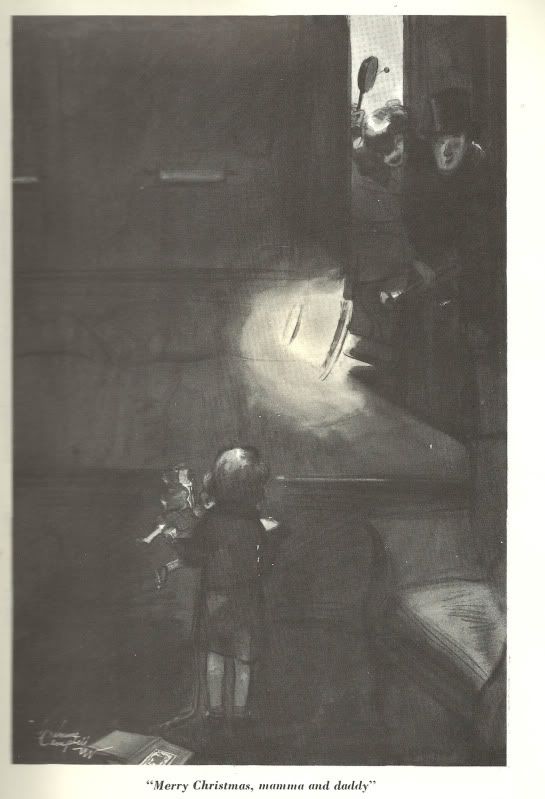
E. Simms Campbell
Good Humor, c.1964
Stu Schwartzberg
Playboy, January 1967
Punch October 6, 1915
Punch October 27, 1915
Real Men, August 1967
Fun House, February 1979
Hello Buddies, May 1955
Esquire, January 1934
Punch December 8, 1915
Swagger, January 1951
Playboy Poland, August 2012
Man, October 1972

Saturday, October 20, 2012

Esquire #1, 2 of 3

Here are more cartoons from the first Esquire of Fall 1933

E. Simms Campbell Photobucket Ty Mahon Photobucket Two from John Groth Photobucket Photobucket Witold Gordon Photobucket E. Simms Campbell

At that time, it was acceptable to show nudity in mainstream media as long as the subjects were not Caucasian. Photobucket John Groth Photobucket William Steig

As the 1980 World Encyclopedia of Cartoons says of him:

WILLIAM STEIG (1907-*) American cartoonist and illustrator born in New York City on November 4, 1907. William Steig attended the City College of New York (1923-25) and then studied at the National Academy of Design (1925-29) In 1930 he submitted some of his work to the New Yorker, and editor Harold Ross liked it enough to hire him as a staff cartoonist for the magazine. In addition to the New Yorker, he has contributed art to the many mass-circulation magazines of our times

Steig refers to himself as a humorous artist, probably because of his continuing interest in more formal styles of representation. He works in watercolors as well as in ink and wash, and his watercolors can be found in the collection of the Brooklyn Museum. Steig is also a wood sculptor whose pieces were found in one-man shows at the Downtown Gallery in 1939 and Smith College in 1940 and today are in the permanent collections of the Rhode Island Museum in Providence and the Smith College Museum in Northampton, Massachusetts.

Steig has been an exceptionally durable figure in the field of cartoon art, but hardly a static one. His early work for the New Yorker was formal in style and strong in the elements of depth and perspective, perhaps due to his parallel involvement in the plastic medium of wood carving. At first realistic, his style began to shift in the 1930s toward caricature and the flat, nondimensional conventions of comic art. A fine example of his exploration of this mode is a set of primitive, deliberately childish panels from the New Yorker entitled “A La Recherche du Temps Perdu”; here he renders recollections from his own childhood in a fashion inspired by Proust. It is a wonderful piece, both as art and as concept, and it is the sort of work that marks Steig as one of the truly thoughtful and innovative artists in a field where being funny need not be the only objective. Like his colleague Steinberg, Steig depends a great deal on pure style. That is not to say, of course, that Steig is not a funny cartoonist; but in recent times he has shown an increasing tendenct to abandon the standard format of cartoon and related caption in favor of small, winsome drawings in the expressionist mode.

Collections of his work, both serious and comic, Include About People (1939), The Lonely Ones (1942). All Embarrassed (1944), Small Fry (1944), Persistent Faces (1945), Till Death Do Us Part (1947), Agony in the Kindergarten (1949), The Rejected Lovers (1951) and Dreams of Glory (1953). He is also a creator of award-winning children's books, including Sylvester and the Magic Pebble (1969), which won the 1970 Caldecott medal; Dominic (1972), which won the 1973 Christopher medal; Abel's Island (1976), a Newberry honor book; and The Amazing Bone (1976), a Caldecott honor book. *He died in 2006
Photobucket John Groth Photobucket Howard Baer Photobucket George Petty Photobucket The final installment of this particular issue next Saturday

Saturday, October 6, 2012

The Last of The Esquire Cartoon Album

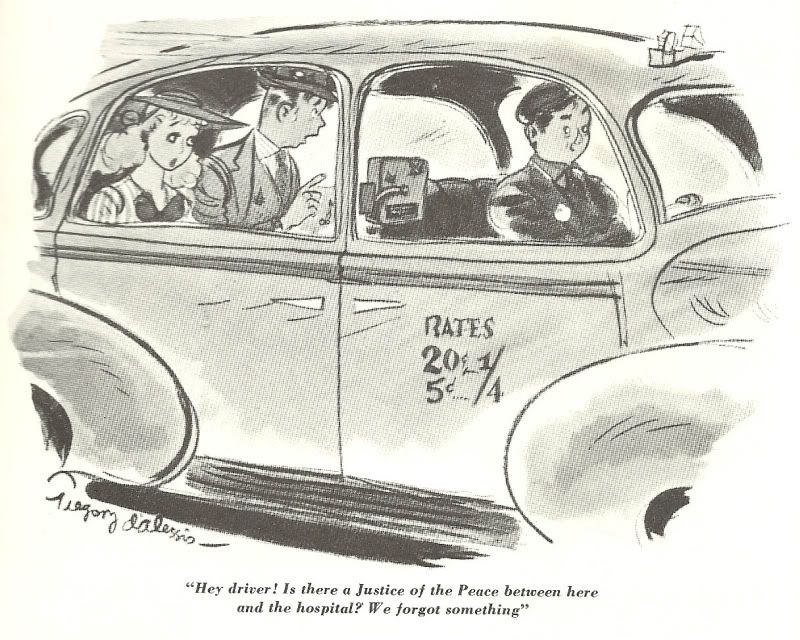
E. Simms Campbell Photobucket Ditto Photobucket Barbara Shermund Photobucket E. Simms Campbell Photobucket Gilbert Bundy Photobucket Gregory d'Alessio, as written about by Bill Crouch, Jr. in the 1980 World Encyclopedia Of Cartoons:

GREGORY D'ALESSIO (1904-*) American cartoonist, painter, and art teacher born in New York City on September 25, 1904. Gregory d'Alessio worked as an assistant to a commercial artist and as a bank teller on Wall Street prior to the Depression. Fired from his Wall Street job, he began freelancing cartoons, at the same time studying at Pratt Institute and the Art Students League. About 1932 he sold his first cartoon to the Saturday Evening Post. This was followed by sales to Collier's, Esquire,the New Yorker and most of the major cartoon markets of the day. In the 1930s his feature Twimbly Twins was published by the Saturday Evening Post. After World War II, Collier's magazine featured his panel Welcome Home, about the arrival of the American troops and the humorous problems that arose.

In 1940 a panel, These Women, starring the svelte secretary Miss Jones, was syndicated by Publishers Syndicate. The panel was stylish, and d'Alessio's quick brushwork gave it a light, relaxing quality, His magazine cartoons were also mostly brush and ink plus wash to the exclusion of much pen work. But since his magazine work was directed to specific audiences, d'Alessio could be more sophisticated in his humor and art than with These Women. A classic Esquire cartoon shows a shapely woman in a fur coat and hat walking past two other sophisticated New York women. One woman says to her companion, “There's a mink, from a rat, on a cat.”

During World War II, d'Alessio was chairman of the committee on war cartoons for the American Society of Magazine cartoonists. The committee worked closely with different government agencies in determining how cartooning would help the war effort and morale of the people.

Gregory d'Alessio eventually decided to end his distinguished cartoon career in favor of painting. He has long been associated with the Art Students League in New York City, where he teaches drawing and anatomy. His wife, Hilda Terry, whom he married in 1938, is one of the foremost women cartoonists in America.

*He died in 1993.
Photobucket Howard Baer Photobucket William Steig. Photobucket George Lichty. Also in the aforementioned Encyclopedia, written by Maurice Horn:

GEORGE MAURICE LICHTENSTEIN (1905-*) American cartoonist born in Chicago, Illinois in 1905. George Lichtenstein showed an early talent for drawing and sold his first cartoon to Judge at the age of 16. After enrolling at the Chicago Art Institute, Lichtenstein reputedly got dismissed in 1924 for drawing moustaches on some of the posters hanging in the school's gallery. The following year he attended the University of Michigan, from which he graduated in 1929. During his college years he edited the Michigan Gargoyle and won first prize in the 1928 College Humor contest.

In 1929 the Chicago Times came into existence, and “Lichty” (as the artist was now known) joined its staff from the beginning, mainly drawing sport cartoons and spot illustrations. In 1930 he created the short-lived Sammy Squirt, a gag strip about a soda jerk. Lichty was to prove more successful in 1932 with his Grin and Bear it, which won immediate recognition and national syndication two years later. In addition to Grin and Bear It (which he drew for forty years, relinquishing it in 1974 to Fred Wagner), Lichty has contributed innumerable cartoons to virtually every magazine in the United States. He was also the author of a satirical anti-Soviet panel, Is Party Line, Comrade, which ran during the 1950s and 1960s.

Lichty's style is a winning amalgam of loose penmanship, slapdash composition and broad humor. He works hard and fast (“I can finish a week's work within two days” he once asserted) with almost no wasted motion or redundance of line. Lichtenstein has received countless honors for his work and is a four-time winner of the National Cartoonist Society's Best Newspaper Panel award.
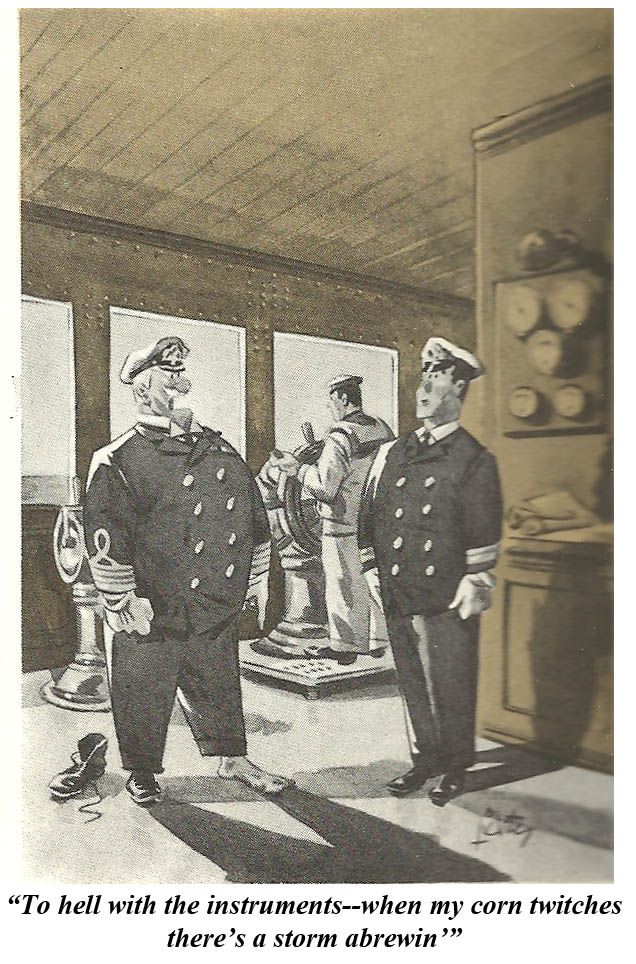
Photobucket The last cartoon in the book, by Abner Dean, I already posted here.

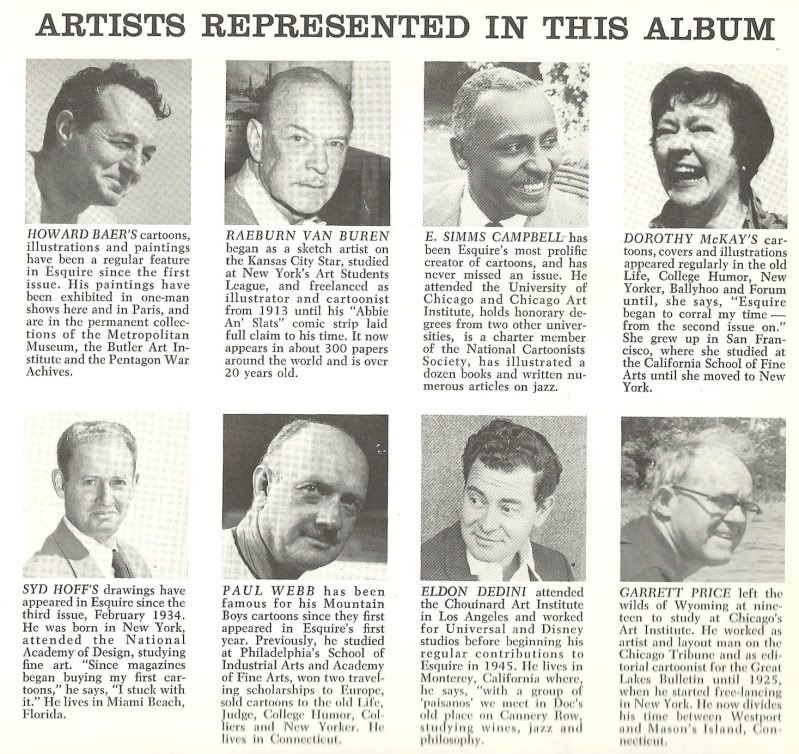
This is the bio page from the last page of the book. If you've been following these posts, you're familiar with everybody's work. Photobucket This is what was under the book jacket. Photobucket Next issue, the very first issue of Esquire.
Saturday, September 29, 2012

Pages 245-249

Continued from last week:

Paul Webb Photobucket Howard Baer Photobucket Abner Dean, written about by Richard Calhoun, in an entry from the World Encyclopedia of Cartoons in 1980:

ABNER EPSTEIN (1910-*) American cartoonist born in New York City in 1910. Known professionally as Abner Dean (a derivation from his mother's name, Deanna), Abner Epstein attended Dartmouth College in Hanover, New Hampshire, from which he received his B.A. In 1931. He then enrolled in the National Academy of Design and continued his art studies. His first work in the field was freelancing, particularly in advertising and industrial illustration. It was probably in this latter capacity that he designed the industrial folding table for which he has the patent.

One hesitates to call Dean a gag cartoonist, though one often laughs at the absurd but familiar antics of his simple, naked pen-and-ink figures, usually set against stark, almost lunar landscapes. A strong vein of alienation, however sardonic, runs through all his work, and his (not uncritical) debt to Freudian psychology is at times naively apparent. His captions are frequently “attitude” words or the intellectual clichés of modernity, and his capricious realization of them is undeniably unique. An example from one of his anthologies,
It's a Long Way to Heaven : a man hanging by the neck from a single blasted tree in one of Dean's characteristically barren landscapes scribbles his way on his “appeal”, his face contorted into a ghastly burlesque of a smile; the caption, “Optimism”. As is so often the case with a Dean work, it is as depressing as it is amusing. (A clue to the reaction Dean is seeking in this and his other cartoons in Heaven can perhaps be found in the brief introduction to the volume, penned by no less an “angry young man” than Philip Wylie).

Perhaps the best brief, serious appraisal of this controversial artist's work comes from Clifton Fadiman's introduction to Dean's anthology
What Am I Doing Here?, published by Simon and Schuster. “The urge to call Dean bats,” Fadiman writes, “will be strong, but that is only because we have so large a vested interest in being 'normal' that we panic easily when this investment is threatened.”

As an artist Dean has been represented in most of the major magazines, including the
New Yorker, and has published no less than eight anthologies of his work, bearing such provocative titles as Come As You Are (1952), Cave Drawings For the Future (1954), Not Far from the Jungle (1956), and Abner Dean's Naked People (1963).

*He died in 1982
Photobucket E. Simms Campbell Photobucket Photobucket Juliette Kida Renault, who did another cartoon in this book. Photobucket Raeburn Van Buren, who was written about by Richard Marschall in The World Encyclopedia of Comics:

RAEBURN VAN BUREN (1891-*) American artist born January 12, 1891 in Pueblo, Colorado, the son of George Lincoln and Luella la Mar van Buren. The young van Buren, showing an early talent for drawing, joined the art staff of the Kansas City Star immediately after graduation from Central High School in Kansas City, Mo., where the family had moved.

Van Buren called the
Star “the best school for pen and ink illustrators in the country” at that time (1909) because its owner, Col. Nelson, eschewed photographs and half-tone drawings. After four years as a sketch artist van Buren traveled to New York to take courses at the Art Students League and freelance illustrations.

The former endeavor ended after a few short frustrating weeks; classes—with Terry Fogarty's father and others—seemed too slow-paced and rudimentary for the talented van Buren. Freelancing was more fertile and rewarding, however. Upon arrival in New York in 1913, van Buren became a frequent contributor to
Life (for which he had been drawing several years already), Puck, Judge, and Street and Smith publications, the pulp, Smith's Magazine, was the first to use a van Buren illustration (his work for the humorous journals was captioned cartoons.)

Van Buren, whose early work betrayed no sign of youth or relative lack of training, soon became one of the country's leading and most polished illustrators. His credits include 368 stories for the
Saturday Evening Post, 127 for Collier's, and numerous others in Redbook (one Life cartoon was enough to prompt Redbook editors to offer a six-part Opie Reid story, “River of Romance” to van Buren, Cosmopolitan, Green Book, Esquire, the New Yorker, McCalls, and newspaper illustrations for King Features Syndicate and the McClure Syndicate.

In the mid-1930's,
Al Capp contacted van Buren and offered him the drawing duties on a comic strip creation, and van Buren accepted on the strengths of Capp's prediction that radio would kill the big magazines. Thus Abbie an' Slats was born in 1937 and van Buren added splendidly to the unfortunately small list of accomplished illustrators in the comics:Alex Raymond and Frank Godwin were brothers in this small band.

Van Buren's art was sometimes distinctive, individualistic and at home with the strictures and conventions of the comic strip. His adaptability was part professional and part due to the guidance of Capp, but was mostly attributed to his overwhelming talent and genuine concern for
Abbie an' Slats. His heroes were handsome and dashing; his heroines racy and winsome; and incidental characters were humorous or villainous to the extreme as the situation demanded.

Van Buren's long work in illustration gave the comic strip a constantly fresh, breezy, and narrative feel. Although some of his magazine work was in crayon, his medium was pen and ink and he was a master of blocking, shading, vignettes and—in the comics—well-used close-ups.

Today(**) he is retired and painting, dividing his time between his homes in Long Island and Florida.


*He died in 1987.

**Today being 1975.
Photobucket Howard Baer Photobucket Barbara Shermund Photobucket Dorothy McKay Photobucket Concluded next Saturday

I hope you like this installment because I spent 20 minutes looking for the mistake in the HTML that was making everything (including the sidebars) italic.