Showing posts with label MORTY MEEKLE. Show all posts

Thursday, August 28, 2014

Comics: The War and After

I continue with the strips from the 1959 history of the comics medium Comic Art In America by Stephen Becker like I do ever Thursday. These strips are from the chapter with the same name as above and these were the captions to these strips:

A daily Vic Jordan by PAINE and WEXLER, 1942. Action and politics mixed.
Claire Voyant awaits a gentleman friend, in this strip by JACK SPARLING.
The Cisco Kid by JOSE LUIS SALINAS, admired by many artists for its draughtsmanship. (1951)
A LESLIE TURNER Captain Easy. Action, guns, and a girl. (1953)
ROY CRANE's Buz Sawyer sees action in the Pacific. (1943)
A quick travelogue by ROY CRANE, in a Buz Sawyer of early 1958. Note the degrees of shading.
DAVE BREGER's G. I. Joe in two manifestations. (1945)
GEORGE BAKER's Sad Sack wins out in the end. The sergeant embodies ferocity.
DICK WINGERT's Hubert wages man's eternal war on his mother-in-law.
ALFRED ANDRIOLA's Kerry Drake is a rarity—a married hero in an adventure strip. Obviously, trouble lies ahead for his waife, Mindy.
A good specimen of DICK CAVALLI's Morty Meekle, almost always a three-panel strip, ending in a healthy laugh. (1959)
COULTON WAUGH's experimental Hank. The date is May 16, 1945, just eight days after the end of the war.
JACOBSEN's old Silent Sam, one of the early pantomime strips. (1935)
MIK's Ferd'nand in a happy moment. (1959)
HARRY HAENIGSEN's Penny. Like all teen-age girls, she is surrounded by hopeless incompetents. (1959)
AL POSEN's Sweeney and Son, with its companion strip, Jinglets. (1957)
A Terry and the Pirates by GEORGE WUNDER, 1955. The strip has lost none of its vigor or popularity.

Thursday, October 6, 2011

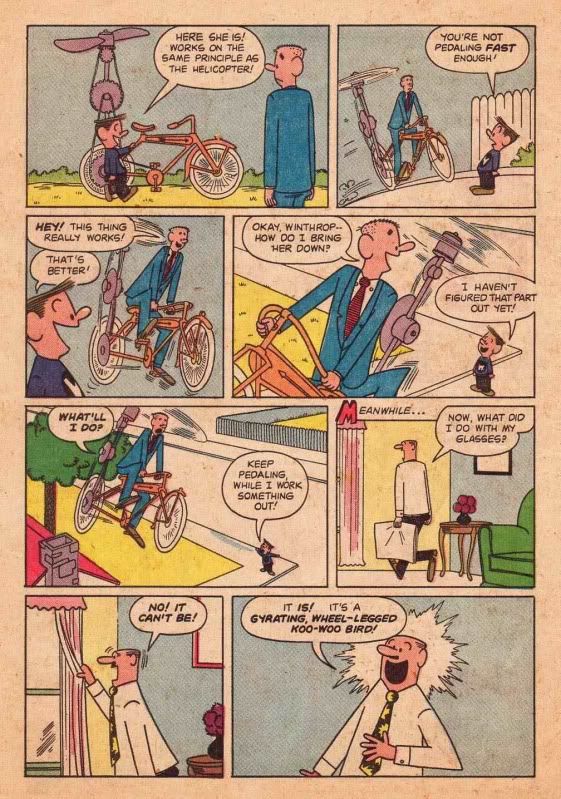
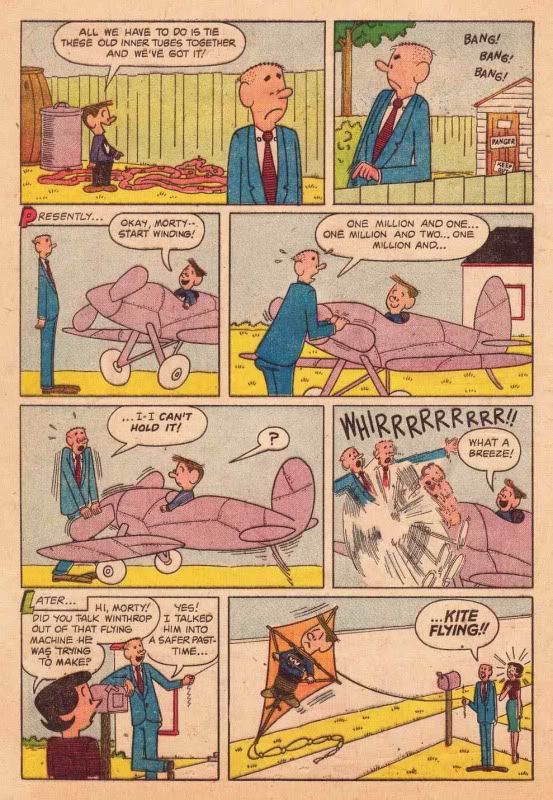
Morty Meekle, 4 of 4


Dell rarely had ads, not even house ads, so they'd often put their 'pledge to parents' within a strip.

Monday, October 3, 2011

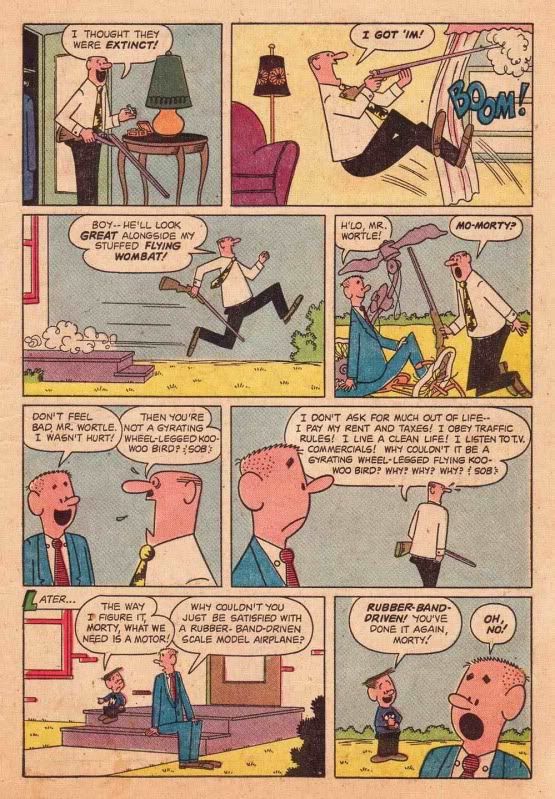
Morty Meekle, 3 of 4

I don't have much to say about Morty Meekle that I didn't say last week.


Concluded on Thursday...

Thursday, September 29, 2011

Monday, September 26, 2011

Morty Meekle, 1 of 4

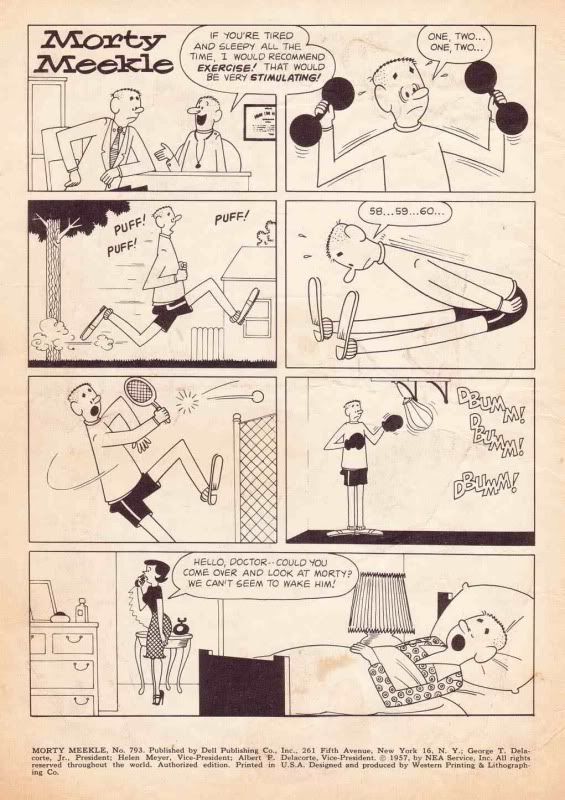
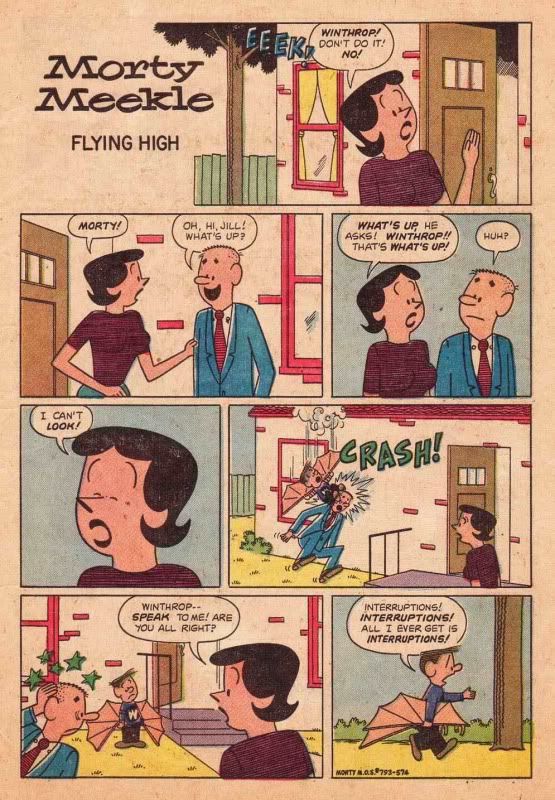
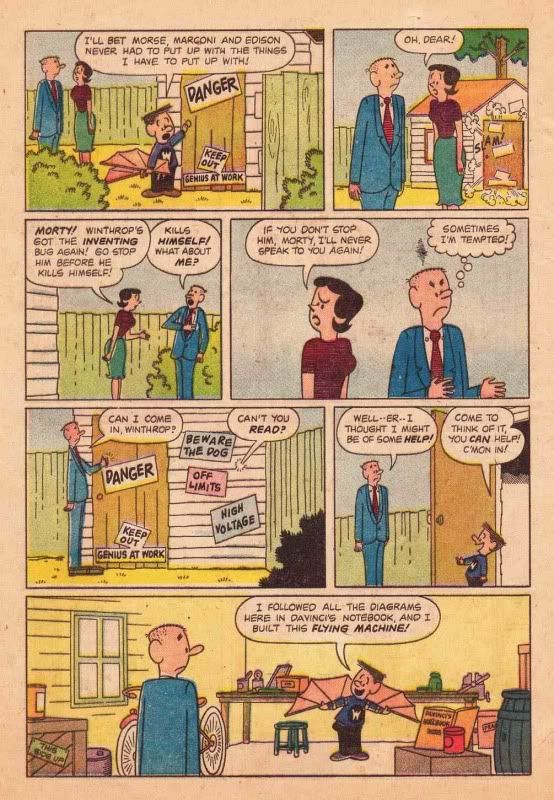
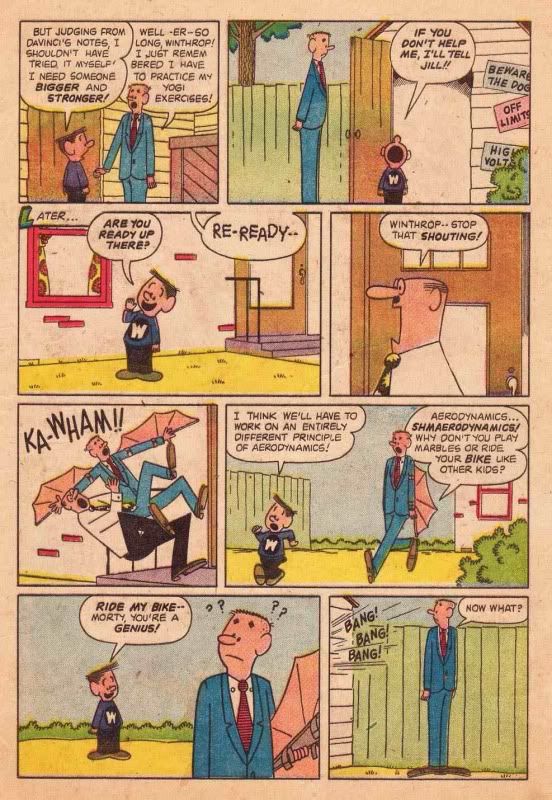
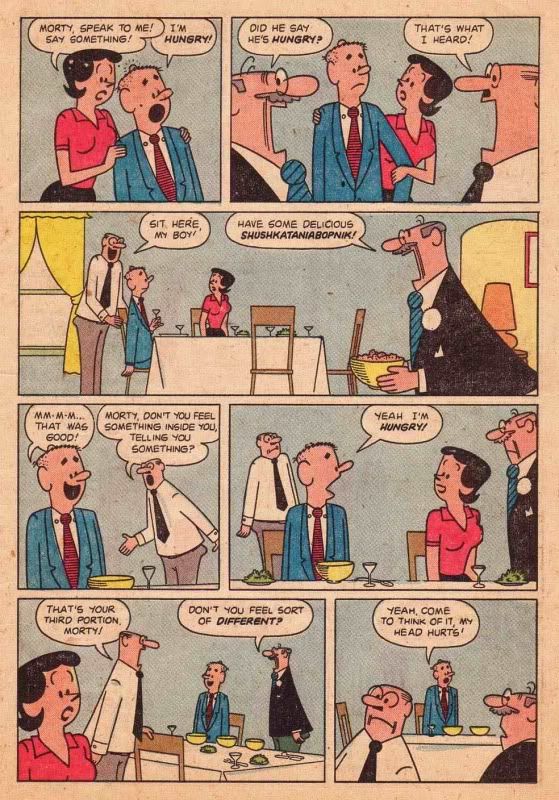
Besides ephemeral TV shows, Four Color Comics also adapted popular comic strips of the time. The creators got the credit on the comic books, though the art was usually done by some anonymous Dell hack (I don't mean that term negatively. By his own admission, C.C. Beck was a “hack”. Some of Dell's best hacks were John Stanley, L.B. Cole, and Sam Glanzman. Though not in this case.)

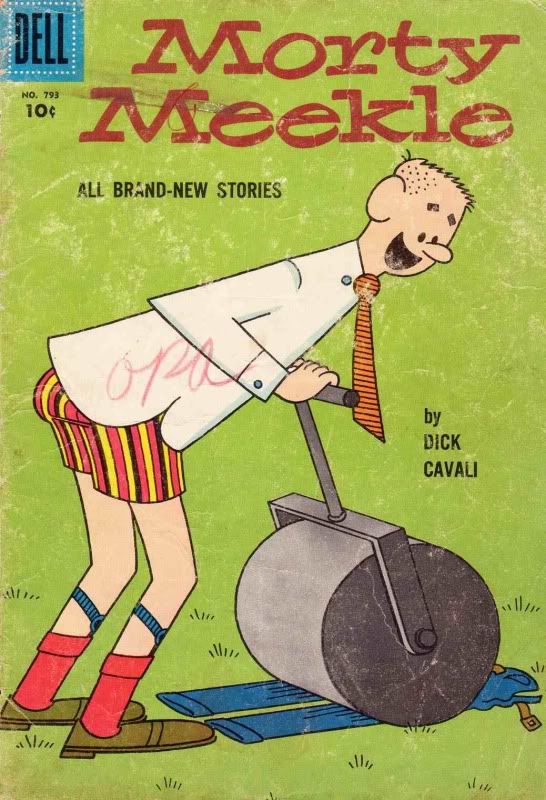
Morty Meekle (later called Winthrop. In addition to forgotten comic strips, Cavalli used forgotten names.) by Dick Cavalli (two Ls, not one as this comic has on the cover) was once a popular strip when there were more newspapers and the comics were still an important part.

This was # 793 from April 1957.
Photobucket
Photobucket
Photobucket
Photobucket
Photobucket
Photobucket
Photobucket
Photobucket
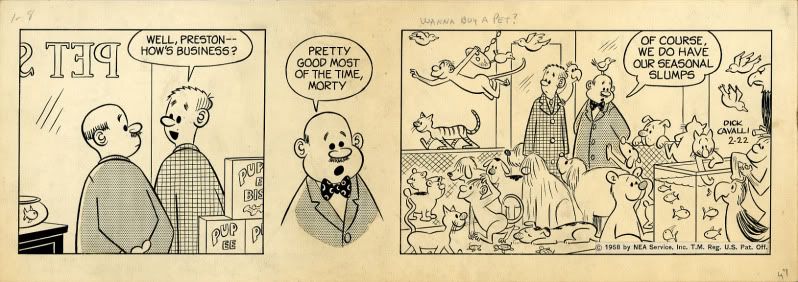
Here's an example Morty Meekle. It's also an example of when strips, even while minimalism was becoming the norm, still had space so they didn't have to be dialogue-driven and show characters from the waist-up. I've known literally hundreds of cartoonists over the years, and every single one of them knows this and wishes it weren't so.
Photobucket
Now I'm off-topic, but in addition to lamenting about the decline of the opportunity for cartoonists to do strips as they would like, everyone has a story about the tools they use going downhill. The originals for things like the pages above used to just be thrown away so as a result you can still get them for a dollar or two, and some artists draw on the backs of them because it's better quality and cheaper than the paper they use.