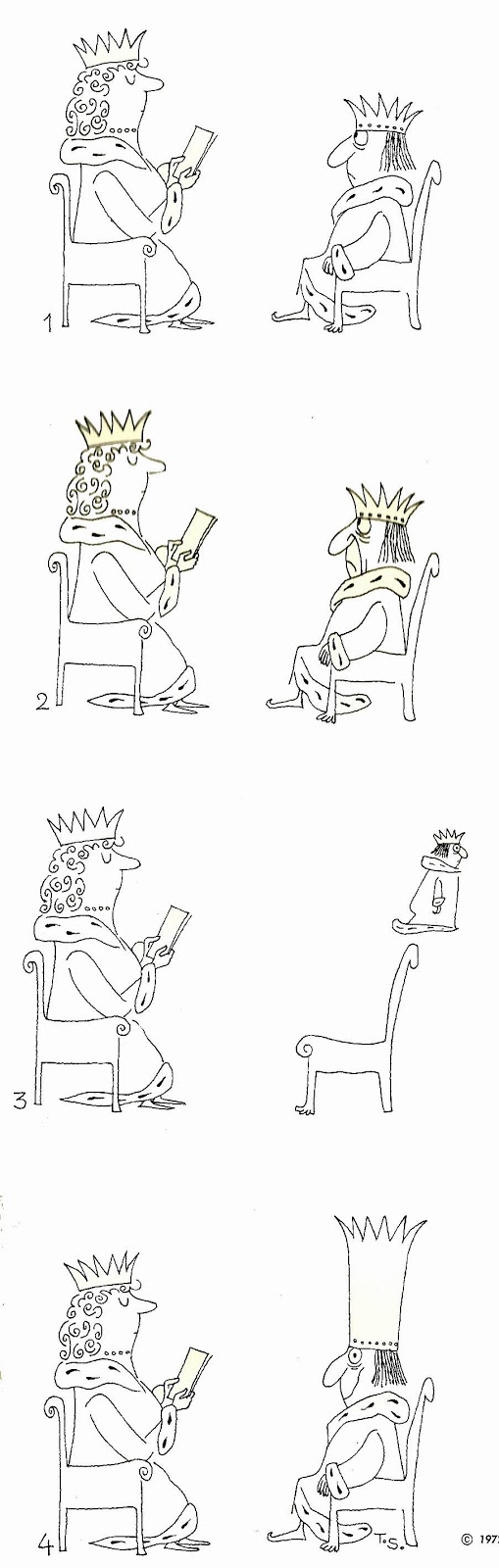
More from Great Cartoons of the World, Series 7. There are probably links to previous ones at the bottom of this post in the LinkWithin boxes.
The first three here were by John Glashan.
Michael Ffolkes
Miroslav Barták for Dikobraz
Jules Stauber doing a motif Virgil Partch was most famous for.
Mischa Richter for the New Yorker
Frank Modell also for The New Yorker.
Lee Lorenz for the New Yorker.
Edward Koren, now Vermont's cartoonist laureate for... see if you can guess.
Terrence “Larry” Parkes in a series of gags for Punch
Showing posts with label TERRENCE PARKES. Show all posts
Saturday, March 1, 2014
Saturday, November 9, 2013
Great Cartoons of the World Series 6, part 5
Continued from last week, excerpts from the 1972 edition of Great Cartoons of the World, Series 6.
From the introduction written by editor John Bailey again:
It is rare of any artist to treat of timeless issues. Very little art of any kind has survived. The timely cartoonist, by contrast, must be ahead of his time and be able to predict a trend. When something new appears he must decide whether or not it is going to fizzle out before he can get his cartoon to market. He must think quickly and think ahead in order to avoid turning in dated work. He deals not only with what is generally current, but with what happened last week and what will happen this week.
It is a common experience to try to remember a funny cartoon, and not quite be able to remember it. Too many fine cartoons are thrown out with the fish. This book, then, is an attempt to put some of the best cartoons between hard covers, where they will be safe. I am perfectly sure that some of them will be valid twenty years hence. And—timelessness is tricky—I am pretty sure that at least a few will be valid a hundred years from now
Another handiwork cartoon from Punch by Terrence “Larry” Parkes Norman Thelwell Jules Stauber J. M. Bosc Ton Smits Norman Thelwell again Robert Day The rest of this post is by John Glashan
Saturday, October 19, 2013
Great Cartoons of the World Series 6, part 2
And now the second installment of Great Cartoons of the World, Series 6 from 1972.
Editor John Bailey writes of the interior:
Most great cartoonists are either timely or timeless. The timeless cartoon is beyond the fashion of the period. A Rembrandt portrait has so much truth in it that the subject is an insignificant Dutchman. In a similar way, the timeless cartoon has little to do with clothing, and is apt to dress its characters in neuter fashion, in the way of Thurber and Lear--a primitive, amoebic form that transcends style and becomes art.
Oddly enough, the timeless cartoon has to do with the Eternal Truth. When you fall over sideways from laughing, it is because the cartoonist has touched upon such subjects as man's search for love, understanding, peace, joy, and power
...
Jules Stauber Donald Reilly in The New Yorker
The introduction speaks of this cartoon in particular:
Reilly's “We've run out of virgins, O Mighty One!” really requires that the reader be a person of some culture, with a knowledge of prehistory, to fully appreciate the point. But no one would have difficulty understanding that the cartoon is in fact a very timely comment on the ubiquitous tourist, who is always finding himself in an ancient scene, equipped with his shoebox-lunch attitude Boris Drucker, for Punch Lee Lorenz also for The New Yorker Ton Smits Leslie Starke, for Punch again Ton Smits Lee Lorenz for The New Yorker Terrence “Larry” Parkes in Punch Jules Stauber Guillermo Mordillo Hans Moser Charles Saxon
Labels:
1970s,
BORIS DRUCKER,
CHARLES SAXON,
DONALD REILLY,
GUILLERMO MORDILLO,
HANS MOSER,
JULES STAUBER,
LEE LORENZ,
LESLIE STARKE,
NEW YORKER,
PUNCH,
STANISLAV HOLÝ,
TERRENCE PARKES,
TON SMITS
Saturday, October 12, 2013
GREAT CARTOONS OF THE WORLD Series 6, part 1
I posted Volume 5 a long time ago, so I've jumped from 4 to 6. Sorry for doing things out of order (it's complicated), but for all intents and purposes it doesn't really matter what order this is in anyway. This is the sixth annual series from 1972, edited by John Bailey.
As the cover flap says of this book:
“All the wold loves a cartoon, for in the cartoon world everyone is represented—the rich and the poor, the successes and the failures, the young and the old—and everyone is equally comic and vulnerable. Once again John Bailey has collected a wealth of fun and fantasy in cartoon form by such figures as William Steig, Terence Parkes, Ton Smits, Vahan Shirvanian, Charles Addams, and scores more. Culled from the richest sources of humor, such as The New Yorker, Punch, and Paris Match, this delightful compendium reveals how universal and timeless cartoons really are.
From political satire to generation-gap quickies, Great cartoons of the World presents a microcosm of the world we all live in, allowing us to view it through the eyes of some of the sharpest and wittiest people drawing today.
As John Bailey says: 'It is a common experience to try to remember a funny cartoon, and not quite be able to remember it. Too many fine cartoons are thrown out with the fish. This book, then, is an attempt to put some of the best cartoons between hard covers, where they will be safe. I am perfectlyy sure that some of them will be valid twenty years hence.'” Jules Stauber George Price in The New Yorker. Michael Ffolkes These next three are from an endless series of gags Terrence “Larry” Parkes did for Punch of a man trying to do “woman's work”. Frank Modell for The New Yorker again. The editor writes of this cartoon in the introduction:
“Some cartoons contain both the elements of timeliness and timelessness. Modell's upside-down stocking, 'You call that hung by the chimney with care?' shows a contemporary child within the context of timeless Christmas. It is the father who has the sense of the historic Christmas.” Charles Elmer Martin Norman Thelwell Anatol Kovarsky William Steig Stanislav Holý
Subscribe to:
Posts (Atom)